


Personal Branding
How To Build Personal Branding For Employees In 2026?
Personal branding has never been more important. Whether you are an entrepreneur or an employee, the way you present yourself online directly influences how others perceive you, what opportunities come your way, and the trust you build with your audience. In fact, half of American professionals say their personal brand mattered more than a strong résumé in 2025, underscoring how critical this has become for career success.
As we head into 2026, the workplace is being reshaped by powerful forces like AI, hybrid work models, a five-generation workforce, and a heightened expectation of authenticity and purpose. All of these personal branding trends make a strong personal brand a must-have career asset for today’s employees.
Why does personal branding carry such weight now? For one, your digital footprint can make or break job prospects. Employers and clients alike trust individuals more than corporate messaging. In this environment, cultivating your personal brand is both a shield and a magnet, a form of career insurance that helps you stand out and attract opportunities. The following guide will explain what personal branding means in 2026, why it is so important for employees, key elements to focus on, and how to build your own brand step by step. We will also look at examples and special considerations for executives and employees in the workplace.
What Is Personal Branding in 2026?
Personal branding is essentially your professional reputation and identity. It is how you market yourself. It encompasses the unique combination of skills, experience, values, and personality that you present to the world. Importantly, a personal brand is not a logo or a one-time image makeover; it is the ongoing story of you. Your personal brand is the body of work you create, how you solve problems, how you communicate, and the clients and collaborators you choose to work with. In short, your brand is about consistently being yourself online and in your career in a way that highlights your strengths and value.
In 2026, personal branding extends across both the digital and real-world realms, from your LinkedIn profile and posts to how you show up in meetings or industry events. Social media remains a major channel for expression, but a personal brand is far more than just a polished profile or a follower count. It is your unique professional identity built through your communications, your content, your network, and even how you appear in search results.
Increasingly, it also means how you are perceived by algorithms and AI systems. Recruiters and platforms use AI-driven tools to filter candidates and surface experts. This means your online information must be not only authentic to human audiences but also optimized for AI discovery. Ensuring your LinkedIn and resume are rich with the right keywords and a clear narrative can help algorithms understand your expertise and connect you with relevant opportunities.
Another hallmark of personal branding in 2026 is an emphasis on trust and authenticity. We live in a chaotic era of branding where everyone is vying for attention across multiple platforms. But the pendulum is swinging away from perfectly curated personas toward more real, human brands. Professionals are learning that being genuine and consistent beats trying to be everywhere or please everyone. Instead of polishing a false image, the most effective personal brands are grounded in authenticity, clarity, and purpose. Amid AI-generated content and information overload, audiences increasingly reward the human touch. Personal brands that showcase a clear voice, real opinions, and lived experience are more trusted than those that are generic or overly manufactured.
So, what does personal branding mean at work? It means taking control of the narrative about you, highlighting the qualities that make you valuable and unique in your profession, and doing so in a way that is visible to the right people. It is about being intentional in how you present yourself every day, both online and offline. This could be through thought leadership content, through the way you engage with colleagues and industry peers, and through the story you tell about your career journey and values. Crucially, it is not about bragging or self-aggrandizement. It is about strategically showcasing who you are and what you stand for. Personal branding is a mix of your vibe, your values, and your voice, and building one simply means showing up consistently and letting your work and character speak for themselves.
Why Personal Branding Is Important for Today’s Employees (2026)
You might be thinking: Is personal branding really necessary if I am not a CEO or an influencer? The answer in 2026 is a resounding yes. Personal branding matters for employees at every level, not just entrepreneurs, because it directly impacts career growth and job security in today’s digital-first, trust-driven environment. Here are several key reasons why personal branding is so important for employees now.
Career Opportunities and Career Insurance
A strong personal brand creates a pull effect where opportunities start finding you. Recruiters, managers, and clients often search online to find talent or to vet candidates. By showcasing your expertise and achievements through your personal brand, you increase the likelihood of being discovered and considered for new roles, projects, or promotions. Conversely, neglecting your online presence can be risky. Surveys show many employers have hired someone because of the content on their personal social media or blog, while over half have eliminated a candidate due to a poor online impression. Your brand can thus be thought of as a form of career insurance. Even if you have a stable job, having a positive reputation and following in your field gives you a safety net and leverage if you ever change jobs or negotiate a raise.
Standing Out in a Competitive Landscape
The job market in 2026 is highly competitive and fast-changing. With AI and globalization affecting many industries, employees need to differentiate themselves more than ever. Without a personal brand, you risk being seen as a commodity, someone with generic skills who might be passed over. A clear personal brand positions you as a specialist or leader in your niche, making you memorable. It highlights why you are different from the hundreds of others with similar resumes. Anyone without a brand is a commodity. By showcasing your unique combination of talents and values, you become the go-to person for certain knowledge or skills, rather than just another name in the company directory.
Credibility and Trust
In the age of information overload, trust is the new currency. Both consumers and employers are skeptical of faceless corporate marketing and resumes full of buzzwords. They crave genuine human connections and evidence of expertise. Personal branding helps establish credibility by allowing you to demonstrate your knowledge and values consistently over time. If you regularly share insightful content or success stories related to your work, people begin to see you as a trusted authority in that area. Within a company, coworkers and managers are more likely to support and promote someone whose expertise and character they recognize. In the broader industry, thought leadership can open doors as decision-makers prefer to get information via a leader’s content over traditional marketing materials. By building your personal brand as a knowledgeable, reliable voice, you gain influence that can accelerate your professional growth.
Network Growth and Influence
Your personal brand and your network feed into each other. A compelling personal brand attracts like-minded professionals and mentors into your network because people naturally want to connect with others who have a clear passion or expertise. Employees’ collective networks are on average ten times larger than their company’s own social media following. When you cultivate your brand and connect with peers on platforms like LinkedIn, you are growing a network that vastly extends your reach. From an employer’s perspective, this means employees with strong personal brands become valuable ambassadors. From your perspective, it means your personal brand helps you build a community of supporters. These connections can lead to learning opportunities, partnerships, and referrals that boost your career. Essentially, an employee’s personal brand multiplies their influence far beyond their formal job title.

Professional Development and Confidence
The process of developing a personal brand forces you to reflect on your strengths, values, and goals, which in itself is beneficial for your career. It encourages continuous learning and improvement since you want to have insights to share and it pushes you to stay current in your field. Employees who actively manage their brand tend to be more proactive in seeking growth. Plus, there is a confidence factor. Taking ownership of your narrative and seeing others respond positively can increase your self-assurance at work. It can motivate you to take on leadership opportunities or voice your ideas more often, knowing that you have a validated identity and expertise to stand on.
Alignment with Company Success
Far from being a threat, employees with strong personal brands are increasingly seen as assets to their employers. When you shine, your company benefits too. Consumers trust employees more than corporate ads, so an employee’s thought leadership can humanize the company brand and build trust with customers. For example, if you have an engineer blog about innovative projects you are working on, it not only boosts your profile but also subtly markets your company as an industry leader. Many forward-thinking organizations realize this and are investing in employee advocacy and personal branding programs. Companies in 2026 are more likely to encourage personal branding because it extends their reach and credibility through authentic voices. By building your brand, you could also become more valuable internally. Often the employees with a strong external presence get tapped for speaking events, press opportunities, or leadership roles because they are seen as representing the company well.
Key Elements of Personal Branding in 2026
Building a personal brand might sound abstract, but there are core pillars that make up any effective professional identity. In 2026, these elements include a mix of timeless fundamentals like authenticity and consistency, as well as new considerations like AI-friendly content. Let’s break down the key elements that employees should focus on.
Authenticity and Values
Authenticity is the cornerstone of personal branding. This means your brand must be built on real values and aspects of yourself, not a fabricated persona. Identify the core values that guide you, such as innovation, integrity, or empathy, and ensure your actions and communications reflect them consistently. When your brand is aligned with your true values, it comes across as genuine and trustworthy. Don’t be afraid to show personality or admit challenges you have overcome; sharing real-life stories can actually strengthen your brand by making you relatable. In a world of slick corporate PR, being human is a superpower. Write down a few principles that are most important to you as a professional. These should shine through in your decisions and content. If you value continuous learning, let your network see that by sharing new things you have discovered.
Unique Value Proposition
One of the first steps in branding is defining what makes you unique. Your unique value proposition is the answer to why someone should choose to work with you or listen to you versus someone else. It is the blend of your top skills, strengths, and passions that set you apart. To figure this out, ask yourself what you do better than most and what problems you love solving. For instance, a marketer who excels at data analysis has a rare combination of creative and analytical rigor. Once you identify this, build your messaging around it. Make sure your online bios and talking points communicate those unique strengths. This clarity helps you attract opportunities that fit your talents.
Personal Brand Story
Facts and figures alone do not make a memorable brand; stories do. Your personal brand story is the narrative that ties together your background, your work, and your purpose. Rather than just listing accomplishments, a good brand story shares the why and how behind your journey. This might include the passion that drove you to your field or the lessons you learned from specific challenges. These personal anecdotes make your brand human and engaging, helping others connect with you on an emotional level. You can incorporate your story into your LinkedIn profile or when introducing yourself at networking events. An effective story shares motivations and milestones that define your career journey.
Expertise and Thought Leadership
A strong personal brand is underpinned by demonstrated expertise. In 2026, employees showcase expertise through thought leadership content. This can include writing articles, creating videos, or posting insightful commentary on social media. The goal is to consistently provide value to others by sharing knowledge, positioning yourself as a go-to resource. It is wise to narrow your focus to a few key topics you want to be known for. Over time, as people repeatedly see you offering useful thoughts on these topics, you will build a reputation as a leader in that space. This not only boosts your credibility but also your employer’s. Quality trumps quantity. It is better to publish authentic, well-thought-out content less frequently than to spam daily posts. Thought Leadership Strengthens Personal Brand. Audiences and algorithms reward depth and originality.
Consistency Across Platforms
Consistency is key to a credible brand. This refers to being consistent over time and across different channels. You need to show up regularly so people know you are active and committed. Consistency also means your message and image align wherever someone finds you. Your LinkedIn, personal website, and in-person introductions should tell a coherent story. If one profile presents you as a corporate expert and another is entirely off-brand, the inconsistency can confuse your audience. Use a similar tone of voice and keep your profile pictures professional. This repetition builds a clear imprint in people’s minds, allowing them to associate your name with something specific and positive.
Online Presence and Visibility
In 2026, your online presence is often the first impression others have of you. Key components include your LinkedIn profile, other relevant social media, and possibly a personal website. To strengthen this, ensure your LinkedIn profile is complete and engaging. Use a professional headshot and a headline that goes beyond your job title to reflect your mission. You do not have to be on every social network, but you should maintain a presence where it matters for your industry. Owning your own website can also be a strong asset, serving as a central hub for your bio, portfolio, and contact info. It is a place where you have complete control over the narrative, unlike social media algorithms.
Engagement and Networking
Personal branding is not a one-way broadcast; it is also about interaction. Building your brand means building relationships. Make it a habit to engage with others both online and offline. This can be as simple as commenting thoughtfully on posts in your field or attending industry webinars. Networking in 2026 is often hybrid, occurring both in person and online. A strong brand combined with networking creates a virtuous cycle where your brand gives you visibility that attracts new contacts, and your network amplifies your brand. Remember to give as much as you take by supporting others’ branding efforts as well.
Adaptability and Evolution
An effective personal brand is not static; it evolves as you grow. Demonstrating that you are continuously learning and adapting can be a brand strength in itself. In 2026, showing that you are aware of new personal branding trends like AI or new best practices in your field sets you apart. Periodically audit your brand to see if your online presence still reflects your current skills and ambitions. Do not hesitate to update your brand story when you hit a new milestone or change direction. Staying relevant is an ongoing effort that keeps your brand authentic and credible.
Personal Branding for Executives in 2026
Personal branding is not just for entry-level or mid-level employees; it is equally crucial for executives and leaders. Executives Can Build a Strong Personal Brand. In 2026, personal branding for executives has become a strategic part of leadership. Whether you are a C-suite leader, a VP, or a founder, your personal image has a direct impact on your company’s brand, employee engagement, and even bottom-line results. Here is why and how executives should approach personal branding.
Thought Leadership and Industry Influence
Executive leaders are expected to be visionaries and standard-bearers for their organizations. By actively sharing insights and participating in public dialogue, an executive can position themselves and their company as industry thought leaders. This could involve writing articles, speaking at conferences, or appearing on podcasts. The effort is worthwhile because the vast majority of business decision-makers say that good thought leadership content is important in shaping their opinions of an industry. Moreover, a lack of executive presence can be a deal-breaker, as many buyers will not engage with a company if its leadership shows poor thought leadership. In 2026, audiences often check a leader’s public presence to gauge the trustworthiness and vision of the company.
Building Trust and Authenticity at the Top
In an era of skepticism, an executive who hides behind corporate communications might seem out of touch. Conversely, when leaders communicate in a personal, authentic way, it humanizes the company and builds trust. Leaders do not need to overshare, but by showing personality and admitting learning moments, they set a tone of transparency. This improves employee morale and public trust. Your reputation travels faster than you do, and in a connected world, news of a leader’s behavior goes far and fast. A positive personal brand based on thoughtfulness and expertise can amplify the company’s reputation and act as a buffer during a crisis.
Talent Attraction and Employee Engagement
Executives with strong personal brands can be magnets for talent. Top candidates often follow industry leaders on social media. If a potential hire sees a company’s leadership sharing compelling visions and engaging with important issues, they are more likely to want to join that team. Research shows that a company’s reputation is heavily influenced by the personal brands of its leaders. Internally, it also sets an example. When employees see leaders actively building their brands, it empowers them to do the same. A socially present CEO can mobilize an entire workforce to become brand ambassadors, extending the company's reach far beyond official corporate accounts.
Executive Brand Strategy
How should an executive craft their brand? Many of the same principles apply, such as authenticity and consistency, but there is an extra emphasis on aligning with the corporate vision. Executives should identify two or three thematic pillars they want to be known for, such as sustainable business, disruptive innovation, or leadership culture. All content and engagements should tie back to those themes. It is also wise to invest in professional branding assets, including a verified social media presence, a professional media kit for speaking engagements, and media training. While not every leader needs a full PR machine, being deliberate about messaging is crucial. Most importantly, leaders must walk the talk. Consistency between words and actions builds the trust that leadership brands rely on.
Authentic Connection Over Marketing
One trap executives must avoid is using personal branding simply as another form of corporate advertising. Audiences can tell if a post or speech is just regurgitated PR fluff. Executive branding should have a personal touch, sharing lessons from the leader’s own career or commenting on broader industry issues. Shares that include leadership philosophies or personal anecdotes tend to perform well because they are unique and human. An executive’s personal brand should complement the corporate brand, not simply mirror it. When done right, it adds depth, allowing people to see the faces and minds driving the company's innovation rather than just a logo.
Personal Branding in the Workplace: Aligning with Your Employer’s Brand
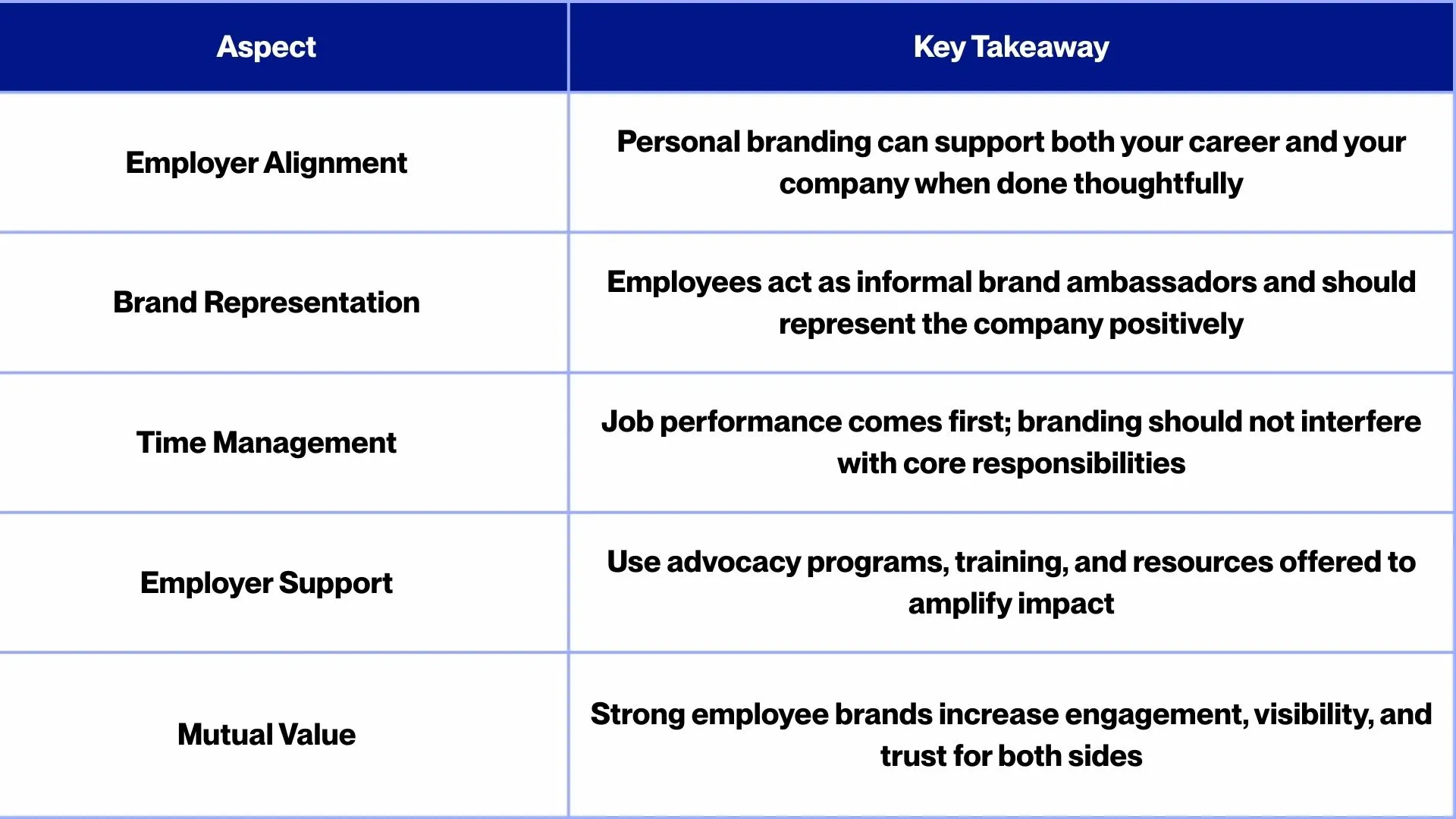
One big question many employees have is how to pursue personal branding without conflicting with their job or employer. It is a delicate balance. You want to promote yourself, but you also have a commitment to your company’s brand and policies. The good news is that, when handled thoughtfully, personal branding can be a win-win for both parties. Companies increasingly recognize that employees with strong personal brands are assets rather than liabilities. Here is how to align your personal brand with your workplace.
Understand Your Company’s Stance
First, get clarity on how your employer views personal branding and social media activity. Many organizations now have social media policies or employee brand guidelines that outline what is acceptable to post. These guidelines are not meant to stifle you, but to protect both you and the company. If your company has a formal employee advocacy program or encourages thought leadership, take advantage of that support. Some companies even provide training on LinkedIn usage or specific content to share. If there is no formal policy, use common sense by avoiding disparaging comments about your employer, skipping inflammatory topics, and keeping non-public information confidential. Aside from those basics, you generally have free rein to discuss your industry.
Align Your Themes
If you can find alignment between your personal brand and your company’s mission, that is ideal. For example, if you work for a renewable energy firm and you personally care about sustainability, building your brand around clean tech thought leadership naturally benefits both you and your employer. You appear as a passionate subject matter expert, and your company gets an unofficial ambassador. Many employers love when employees champion topics that align with the company’s values because it amplifies the corporate message organically. However, it is also okay if not everything you talk about is directly related to your company’s business. Just be aware that focusing on a vastly different domain might not contribute to your career advancement at that specific company.
Be a Positive Representative
At its heart, personal branding in the workplace means you become a brand ambassador for your employer. If you speak at a conference or write an article, people will associate you with the place you work. Always be mindful of representing your employer in a positive light. This does not mean you can never have independent opinions, but you should handle any differences professionally and privately rather than airing grievances in public. Focus on areas of pride, such as highlighting cool projects or praising aspects of the company culture. Research shows that people find employees’ voices highly credible, often trusting them more than a generic company post.
Addressing Time and Commitment Concerns
One challenge employees face is when to build a brand, since your primary focus during work hours should be your job duties. It is important to ensure that your branding activities do not interfere with your performance. In fact, excelling at your job is the first step to a great personal brand. You may need to do some of your content creation or networking on your own time. However, if your branding closely ties to your work, such as a sales rep building a LinkedIn presence for leads, employers might count it as part of your work effort. Have open conversations with your manager to let them know you are building a professional presence and how it could benefit the team.
Handling Confidentiality and Professionalism
A key workplace issue is making sure you respect confidentiality. Always err on the side of caution. If you are working on something not yet public, do not tease it. If you had an internal setback, do not vent about it online. Share experiences at a general, insightful level rather than discussing specific internal matters. Additionally, maintain professional decorum. Before posting anything edgy, ask yourself if you would say it in a room full of your colleagues and your boss. If the answer is no, reconsider. Keeping this in mind can prevent career-damaging missteps while still allowing you to have a constructive and respectful voice.
Leveraging Employer Support
If your employer offers resources for personal branding, such as workshops or internal mentorship, use them. A company might run an advocacy program where they provide pre-approved content for you to share. You can use that as a starting point and add your personal twist, as authentic posts get far more engagement than copy-paste ones. Some might even highlight employee posts on the company page, giving you more exposure. When companies invest in these areas, it is because they see a return on investment. Employee-driven content can yield significantly more engagement than corporate posts. It is a symbiotic relationship when done right.
Personal Branding Examples for Employees in 2026
Sometimes the concept of personal branding can feel abstract, so let’s look at some concrete examples of employees and leaders who have developed strong professional identities. These examples span different roles and industries, illustrating how personal branding works in practice.
The Social Intrapreneur
Aisha is a software engineer at a large tech company. Aside from doing great work in her day job, Aisha has built a personal brand as a thought leader in AI ethics. She regularly posts insightful articles on LinkedIn about responsible AI development, drawing on general experiences from her work. She also shares coding tips on social media and speaks at meetups about diversity in tech. Over time, Aisha has gained a following of engineers and tech enthusiasts. This has led to invitations to appear on podcasts and contribute to open-source projects. Internally, she is now seen as an authority on AI ethics and was asked to lead a company task force. This example shows an employee aligning a personal passion with her industry, benefiting both her career and her company’s reputation.
The LinkedIn Influencer Employee
John is a sales manager at a software company. He has cultivated a personal brand by sharing short, valuable posts about sales leadership, productivity hacks, and lessons learned from deals. He injects personality by using storytelling, such as sharing how a failed pitch taught him humility. John’s consistency has paid off; he now has thousands of followers, including many potential clients. As a result, prospects reach out to him specifically to do business. John’s company is thrilled because his personal posts generate more engagement than their official marketing. John demonstrates how a non-executive employee can become a brand ambassador and drive real business results through personal branding.
The Executive with a Mission
Strong leadership brands are often mission-driven. Consider leaders who build a famed personal brand centered around empowerment or advocacy. By discussing challenges openly and sharing advice on leadership or resilience, a leader can become a prominent figure beyond their corporate role. People see them as authentic champions for change. This works because the brand is empowering and deeply aligned with a cause. Employees at any level can emulate this by identifying a theme they genuinely care about, such as mental health at work or sustainability, and weaving it into their professional narrative. When your personal brand stands for something greater, it resonates widely.
The Multi-platform Creative
Priya is a mid-level designer at a retail company. Her personal brand is all about creative storytelling and growth in the design field. On visual platforms like Instagram or TikTok, Priya shares behind-the-scenes looks at her design process and quick tips for students. She also writes blog posts about communication lessons learned in her role. Her genuine approach has attracted a community of peers. She has been invited to take over magazine accounts and speak at virtual conferences. Meanwhile, her employer now taps her to represent the brand at recruiting fairs. Priya shows that you can use visual mediums to build a brand that helps you and attracts talent to your firm.
The Knowledge Sharer
Not all personal branding is public. Raj works in a finance role and is not very active on social media. Instead, he has built a strong personal brand within his company as the go-to expert for financial modeling. Raj started an internal newsletter where he breaks down complex topics for colleagues and frequently presents workshops to other departments. He is effectively branding himself inside the company as a knowledgeable and helpful expert. This has earned him cross-department respect and a recent promotion. Raj reminds us that personal branding can happen on internal platforms like Slack or the company intranet and can be just as valuable for career growth.
How to Build Your Personal Brand in 2026: A Step-by-Step Guide for Employees
Now that we have covered the fundamentals and seen some examples, let’s get practical. How do you actually build your personal brand as an employee in 2026? This step-by-step guide can serve as your personal brand playbook, even if you are starting from scratch.
1. Define Your Brand Vision and Audience
Start by clarifying your goals and who you want to reach. Ask yourself what you want to be known for and who your target audience is. Are you trying to reach recruiters, potential clients, or peers in your profession? Knowing this helps you tailor your content. Write down a short personal brand statement for your own focus. For example, you might decide to be an advocate for data-driven marketing who helps demystify analytics for others. This vision gives you a North Star to ensure your efforts align.
2. Craft Your Unique Value Proposition
Pinpoint what makes you distinctive professionally by combining your top strengths and passions with a twist from your background. Try to boil this down to a concise statement, such as a project manager who bridges tech and business or an accountant with a creative streak. This statement serves as your elevator pitch, guiding which opportunities you pursue and what content you create.
3. Develop Your Brand Story
Expand on your value proposition with storytelling. Outline your journey, including how you got to where you are and why you do what you do. Identify a few key elements, such as a major challenge you overcame or the moment you found your passion. Ensure your story includes human elements like motivations and lessons rather than just a dry resume recap. Draft a professional bio in narrative form for your LinkedIn About section to convey your personality and values.
4. Optimize and Polish Your Online Profiles
In 2026, your online profiles are your digital storefront. Ensure your LinkedIn is complete and engaging by updating your headline to reflect your skills beyond your job title. Use a clear, friendly photo and rewrite your summary in the first person. For other platforms like X or Instagram, maintain a thread of consistency in your bio and image. If you have a personal website, keep it updated as a central hub for your portfolio and contact information.
5. Start Creating and Curating Content
This is often the most impactful part of branding. Begin sharing content that reflects your expertise. If you enjoy writing, try LinkedIn articles; if you prefer video, create short clips. You do not have to be the world’s foremost expert to be helpful. Share things you have learned from a recent project, commentary on industry news, or a how-to guide on a task you know well. Consistency is more important than viral brilliance, so aim for a regular schedule you can sustain.
6. Network and Build Relationships
Leverage your growing presence to make new connections. Send brief, personalized notes when connecting with people in your industry. Join virtual communities or professional groups and be visible by contributing to conversations. Networking is often where unexpected opportunities spring from, such as being invited to contribute to an article or getting a job referral. Remember to give back by answering questions and offering advice to those who are more junior in their careers.
7. Be Consistent and Patient
Building a brand does not happen overnight. It can take months to get noticeable traction. Create a manageable routine, such as posting once a week or attending one networking event a month. Over time, these small actions compound. Do not get discouraged if your early content does not get much reaction; focus on the quality of your interactions rather than just the quantity.
8. Monitor Your Brand and Iterate
Periodically assess how you are doing. Google yourself to see what a stranger would find. Ask colleagues for feedback on whether your online presence feels authentic and compelling. Pay attention to which posts resonate most with your audience and lean into those topics. If you feel your career goals are shifting, steer your brand in a different direction by intentionally changing your focus.
9. Avoid Common Pitfalls
Be careful to avoid a few common mistakes. Always remain authentic rather than creating a misleading persona. Avoid purely self-promotional posts and focus on providing value to others. Most importantly, do not engage in unprofessional behavior that could tarnish your image. Personal branding is a long game, and maintaining professionalism will guard your reputation over time.
By following these steps, you create your own guide for professional growth. The goal is to become known and trusted in the space that matters to you. Your personal brand is already out there through your digital footprint; by actively managing it, you ensure the story being told is the one you want.
Conclusion
In the dynamic world of 2026, personal branding for employees is no longer optional; it is a critical component of professional success. Personal branding, at its core, is about taking charge of your own narrative. It is about highlighting the best you have to offer and ensuring that your colleagues, bosses, and industry peers recognize the unique value you bring. We have seen that a well-crafted personal brand can open doors to new jobs, foster trust and credibility, expand your network, and even bolster your current employer’s reputation. In a time when technology and AI are transforming work, your personal brand is the one thing that sets you apart as irreplaceably human and authentically you.
To recap, start by understanding what personal branding means today. It is far more than a slick image; it is your values, expertise, and personality shining through consistently. Recognize why it matters. From hiring decisions to company trust, the data is clear that those who invest in their personal brand reap tangible rewards. Focus on the key elements: authenticity, clarity in your strengths and story, consistent presence, and thoughtful engagement. We also explored how even top executives leverage personal branding to lead effectively and how employees can align their brand with their workplace for mutual benefit. Personal Brand Strategy Examples show that there are many paths to success, but all involve being intentional and true to oneself.
The journey of building your personal brand is one of self-discovery and continuous growth. The year 2026 will surely bring new platforms, trends, and opportunities to showcase your professional identity. By laying the groundwork now, defining your brand and actively nurturing it, you will be ready to adapt and shine in any environment. Remember, every employee has a personal brand whether they actively shape it or not. The question is, will you take control of yours?
Hopefully, this comprehensive guide has given you not only the why and what, but also the how to master personal branding for yourself. The sooner you start, the sooner you will see the impact, whether it is the recruiter who contacts you because of a post you wrote or the coworker who is inspired by your journey. Go ahead, be bold, and let the professional world know who you are and what you stand for. In doing so, you will not just build a brand; you will build a legacy for your career that carries you forward in 2026 and beyond. Contact OhhMyBrand today to learn more about how to transform your name into a brand that opens doors. Let’s work together to make you not only visible but unforgettable in your field.


.svg)
.svg)
.svg)
.svg)



.svg)