



Personal Branding For Women
How To Stand Out In Personal Branding For Women In Finance?
Imagine walking into a room where everyone recognizes your company’s name but has no idea who you are. It is like being a ghostwriter of your own career story. For many women in finance and financial services, this scenario is all too familiar. They may be excellent at representing their organization, yet a crucial piece of the puzzle is often overlooked: their personal brand.
In a competitive, traditionally male dominated field like finance, cultivating a strong personal brand is not an optional add on. It is an essential strategy for career success. A well-crafted personal brand helps you showcase who you are, highlight your expertise, and ensure you get recognized for your contributions rather than just the company you work for. In this inspirational, conversational guide, we will explore why personal branding matters so much for women in finance, the unique challenges you might face, and how to build an authentic brand that propels your career on a global stage.
Why Personal Branding Matters for Women Financial Professionals

In 2026 and beyond, a strong personal brand is important for all professionals but it is especially crucial for women in finance. Women account for roughly half of the working age population, yet hold only 35% of management roles globally, according to the International Labour Organization. In the finance and insurance industry, the gaps are even more striking. Men in finance take home significantly more pay and ascend to leadership faster than their female counterparts. Women make up 52% of finance sector employees but only about 27% of C-suite executives. These numbers highlight a leadership gender gap, and personal branding can help bridge it.
Increasing Visibility and Credibility
Research shows women are often misjudged as having less leadership potential than men due to pervasive biases. A clear, confident personal brand helps disrupt that narrative by giving colleagues and decision makers a fuller picture of your capabilities. It ensures your voice is heard and speaks for you even when you are not in the room. In fact, women who intentionally articulate their value are more likely to be recognized, receive high profile assignments, and attract new opportunities.
Standing Out in a Male Dominated Industry
Finance has historically been a male driven field, and unconscious biases can sometimes obscure women’s accomplishments. Bias thrives in uncertainty where leaders default to assumptions. By proactively shaping your reputation and telling your own story instead of letting others assume, you counteract stereotypes with evidence of your strengths. An authoritative personal brand showcases your unique expertise in financial matters, helping you stand out as a leader rather than blending into the background.
Earning Trust and Clients
In financial services, trust is currency. Money is personal and clients will only work with advisors they find credible and trustworthy. Cultivating a personal brand as a financial advisor is critical to winning and retaining clients because it builds that trust over time. From the moment someone hears your name or sees your profile, they begin forming opinions. By presenting a consistent, authentic brand, you control those first impressions and signal that you are competent and reliable. In short, your personal brand can financially impact the outcomes of client engagements as it is part of what convinces people to choose you over the competition.
Attracting Opportunities and Allies
A strong brand does not just draw attention. It draws advocacy. Many women are reluctant to promote themselves due to cultural norms or fear of being seen as bragging. But a well-defined personal brand can naturally attract sponsors, mentors, and allies who champion you and open doors on your behalf. When others clearly understand your value, they are more able to refer you for promotions, recommend you for boards or speaking engagements, and celebrate your achievements. This external advocacy ensures you get the credit you deserve and helps accelerate your advancement.
Countering Bias and Changing Perceptions
Women in finance often walk a tightrope between being a team player and being labeled as self promoting when highlighting their successes. Personal branding can help change this perception dilemma. By confidently broadcasting your accomplishments and strengths in a professional manner, you are framing it as sharing value rather than self aggrandizement. It fills the vacuum of uncertainty with a clear narrative about who you are and what you are capable of, leaving less room for others’ unconscious bias to define you. Over time, this can shift how leadership and colleagues perceive not just you, but women in finance generally as capable leaders who belong at the table.
Building Confidence and Combating Impostor Syndrome
Crafting your personal brand is also an exercise in self recognition. Many high achieving women still grapple with impostor syndrome or self doubt, especially in industries where they are underrepresented. A well-defined personal brand reinforces your identity and purpose. By creating content, sharing your story, and articulating your wins, you remind yourself and others of your own value, which boosts your confidence. It is a grounding tool during performance reviews or big meetings because you know exactly what you stand for and what you have achieved. As your achievements become visible and acknowledged in your branding, that confidence only grows.
Career Resilience and Personal Asset
Your personal brand is an asset you carry with you throughout your career, regardless of employer. It offers visibility, influence, and even income opportunities that stay with you, not just your company. In an era where roles and companies can change quickly, having a strong brand means you are not starting from scratch each time because people know your reputation. In other words, much like how personal finance is important for monetary security, personal branding is important for career security and growth. It gives you a degree of independence and stability because your name becomes synonymous with value in your field.
Personal branding for women in finance is about claiming and communicating your worth. It increases your visibility in an industry where women have historically been overlooked, and it equips you with a platform to bypass biases, build trust with clients and colleagues, and accelerate your professional growth. As one leadership expert put it, in today’s market where representation is still catching up to talent, your personal brand is not just a tool, it is a lever for amplifying your impact.
Navigating Gender Bias and Challenges in Finance
To understand why branding is so critical, we must acknowledge the unique challenges women in finance often face. Despite progress, finance can still feel like an old boys’ club, with ingrained biases and structural hurdles. Here are a few realities and how personal branding helps address them.
Breaking Stereotypes and Glass Ceilings
Women financial professionals frequently encounter stereotypes that underestimate their leadership potential. Research has found that women are consistently misjudged as having lower leadership aptitude. There is also often a double standard where behavior admired in male leaders might be seen as aggressive or unlikable in a woman. This creates an internal conflict: do you stay low profile to be liked, or speak up and risk criticism? Personal branding offers a solution by allowing you to redefine the narrative around yourself. Instead of being defined by a role or by others’ assumptions, you actively present your own multifaceted story. By showcasing your individual strengths and values through your brand, you remind people that you are more than just an employee at a specific bank. You are a thought leader, an expert, and an innovator in your own right.
The Fine Line Between Confidence and Self Promotion
Society can be reluctant to accept women who boldly showcase their talents and achievements. The result is that many women err on the side of humility, hoping their work will speak for itself. But in competitive fields like finance, work alone is not always loud enough. People do not promote what they do not see. If you stay heads down, you risk invisibility despite great performance. A personal brand helps you walk that line by packaging your accomplishments in a narrative that feels purposeful rather than boastful. Branding is not bragging; it is clarity. You are making sure your impact does not go unnoticed or uncredited. By regularly and authentically highlighting results you have delivered, you assert your leadership in a factual way. This not only combats the fear of appearing self promoting, but it also normalizes women owning their success.
Lack of Representation and Mentors
With relatively few women in senior finance roles, it can be hard to find role models or sponsors who relate to your journey. Some male leaders may also mentor and promote people who look like themselves, which contributes to fewer women rising up. Personal branding cannot single-handedly fix systemic bias, but it can significantly improve your odds of being noticed by the right people. When your personal brand clearly communicates your ambitions and strengths, potential mentors or advocates have an easier time recognizing what you bring to the table. You essentially make it easier for others to see you as a leader. Moreover, by increasing your visibility through speaking, writing, and networking, you expand your circle of influence and the chance of crossing paths with high level sponsors.
Overcoming Confidence Gaps
Studies suggest that men often apply for jobs or promotions when they meet only a portion of the requirements, whereas women often feel they need to meet every single one before trying. This confidence gap means women may hold back in advancing their careers. By actively managing your personal brand, you proactively remind yourself of your qualifications and expertise, which can embolden you to go for opportunities sooner. Your brand becomes a confidence booster. It is like having a ready answer to the question of why you are the right fit because you have already outlined your value proposition. This reinforced self assurance can push you past internal doubts. Additionally, as your brand gains recognition, others will start seeking you out for opportunities, flipping the script so you are being invited rather than always asking.
The financial sector comes with challenges like pay gaps, promotion gaps, and biases, but cultivating a strong personal brand is one of the most effective ways to navigate and mitigate those challenges. It helps turn stereotypes on their head by showing evidence of your leadership and positions you to claim your seat at the table with confidence.
Key Strategies to Build Your Personal Brand in Finance
Building a brand is a journey that involves introspection, consistency, and courage. Here are some actionable strategies and tips tailored for women in finance and financial services to help you create a compelling presence that stands out.
Define Your Brand Identity with Authenticity
Every strong brand starts with self-awareness. Take the time for introspection and define what your personal brand stands for. Ask yourself about your core values, your strengths, and what you are most passionate about in your finance career. The answers to these questions form the foundation of your brand, representing your why and your differentiators. This self-reflection is the bedrock of your professional identity.
From there, craft a personal brand statement which acts as a concise mission statement for yourself. This does not necessarily need to be published verbatim, but it guides how you present yourself. For example, you might be a fintech strategist dedicated to merging financial innovation with inclusive growth, or someone who helps clients secure their future through empathetic, evidence-based financial planning. A clear brand statement encapsulates your value proposition in a way that resonates with your target audience. Think of it as the headline for Brand You.
Most importantly, be authentic. Authenticity is the core of a powerful personal brand. Embrace your genuine self, including your background, personality, and quirks, because that authenticity is what will differentiate you. In the long run, trying to be someone you are not is exhausting and unsustainable. Personal branding is not about creating a fake image; it is about authentically representing who you are and what you stand for. Women in finance might sometimes feel pressure to conform to a certain mold, but your unique story and viewpoint are assets. Whether you are a data-driven introvert or a gregarious networker, build your brand around the real you. People can sense when someone is genuine, and it builds trust.
Communicate with Confidence and Clarity
How you communicate day to day significantly shapes your personal brand. Start by eliminating undermining language that can chip away at your perceived confidence. Many women and men have a habit of using qualifiers and apologies, such as saying I just wanted to say or I think maybe. While often done out of politeness, these can unintentionally signal self-doubt. Aim to speak with purpose by using clear, direct language to express your ideas and recommendations. For instance, instead of saying you just thought the team could perhaps consider reducing risk, simply recommend reducing risk exposure and explain why. Removing needless softeners makes your expertise shine more clearly.
Email and written communication count as well. Avoid phrases that diminish your authority. You do not need to start every email by saying you are no expert if the topic is within your area of expertise. This does not mean adopting an unnatural tone; it means stripping out habitual self-minimizing phrases. By communicating confidently, you brand yourself as confident. Research suggests that women who clearly articulate their value and contributions tend to gain more recognition and opportunities. It is not about being louder; it is about being clearer.
Also, remember that silence or invisibility sends a message of its own. If you rarely speak up in meetings or keep your camera off in virtual calls, colleagues might subconsciously perceive you as less engaged or less influential. Make it a point to contribute regularly in discussions, ask questions at industry events, or voice your perspective on team strategy. These actions, repeated over time, shape a narrative that you are a present and active participant in the finance community. If you say what you mean and say it with your head held high, your personal brand will reflect that strength.
Increase Your Visibility Strategically
In personal branding, visibility is power. You want to be known not just within your firm but in the wider financial industry. This does not require boasting; it requires sharing and engaging in the arenas that matter. Here are a few ways to boost your visibility.
Thought Leadership and Content
A great way to get noticed is by contributing your ideas publicly. Write articles or blog posts on topics you are knowledgeable about. For example, an investment analyst might write commentary on market trends, or a financial planner might share tips on retirement strategies. Publishing insights on platforms like LinkedIn, industry blogs, or even respected finance publications helps build credibility and shows you have a voice.
Remember, your content does not have to be perfect; it just has to be authentic and valuable to your audience. Some women shy away from putting content out there, worrying about whether they are the ultimate expert. Do not let perfection paralysis stop you. Sharing your perspective, backed by your experience, positions you as a resource to others and widens your reach. Over time, people start associating you with the subjects you frequently speak or write about, which is exactly what you want in a personal brand. Thought Leadership Strengthens Personal Brand!
Leverage Social Media
In the finance world, LinkedIn is the go-to platform for professional visibility. Ensure your profile is up to date and does not read like a dry resume. Use the headline and summary to convey your personal brand statement. Post content or share articles with your take on them. Even commenting thoughtfully on others’ posts can increase your visibility among peers.
If your online presence is minimal, you risk being invisible in today’s digital age, and visibility is credibility. People will search for you online; make sure what they find reflects well on you. You do not have to be active on every social platform, but do maintain a strong presence where industry professionals gather. Engage with others, build relationships online, and expand your network beyond the four walls of your office.
Public Speaking and Events
Nothing establishes credibility quite like standing in front of a room and sharing knowledge. Look for opportunities to speak at industry conferences, panels, or even internal company events. If you are newer to public speaking, start small by participating in a local society meeting or a university panel. These appearances not only bolster your confidence but also put you on the radar of industry colleagues. When you speak on a topic, you are branding yourself as an authority in that space. It might be nerve-wracking at first, but each talk or panel is a chance to reinforce your values, expertise, and personality to a live audience.
Networking Broadly and Meaningfully
Visibility is also about who you know and who knows you. Make an effort to network beyond your immediate circle. Many women inadvertently keep their network too narrow by staying only within their company or specific niche. Broaden your reach by connecting with colleagues in different departments or joining professional associations such as Women in Finance or banking networks.
By diversifying your network, you expose yourself to new ideas, collaborations, and champions in different areas. For example, a connection in another department could alert you to a high-visibility project, or a fellow member of a professional group might recommend you for a speaking slot. A broad network makes it more likely that when opportunities arise, someone thinks of you. This all feeds into a personal brand that is known across the industry rather than in a silo.
Be Consistent Across Platforms and in Person
Consistency is key to any strong brand, whether corporate or personal. This means aligning the way you present yourself in all contexts so that a clear, cohesive image of you emerges. Let’s break down a few areas where consistency matters most.
Messaging and Tone
Ensure the themes and values you talk about align everywhere. For example, if your brand is about financial empowerment for others, your LinkedIn posts, conference talks, and even internal communications should consistently reflect that ethos. Repetition of core messages builds memorability. If someone glances at your social media feed, they should get a quick sense of what you care about professionally.
Consistency in tone matters too. If your style is analytical and insightful, embrace that; if it is optimistic and enthusiastic, that works as well. Just aim for a steady voice. This does not mean being robotic, but the overall impression should harmonize. A consistent message across platforms builds trust and credibility because people come to know what to expect from you, which is comforting in the fast-paced world of finance.
Visual and Professional Image
The way you present yourself physically can become a recognizable part of your brand. This includes your professional headshot, your manner of dress, and even your body language. Start with a high-quality, up-to-date photo on LinkedIn where you appear confident and approachable.
Next, consider your style at work or events. You do not need a designer closet, but aim for a look that makes you feel confident and aligns with how you want to be perceived. Whether that is sharp and bold or simple and reliable, the key is polish and authenticity. If bold colors or a signature accessory make you feel empowered, go for it. Dressing in a way that reflects pride in yourself and respect for your environment subconsciously signals that you are put-together and attentive to detail.
Body Language and Presence
Beyond clothing, think about your presence in the room. Do you make eye contact and project confidence in meetings? Small things like a warm smile or confident posture when presenting can reinforce the personal brand of a capable leader. These non-verbal cues should match the message you send on paper. If your brand is that of a calm and trustworthy advisor, then an unfocused presence would be off-brand. Strive for congruence between how you appear and how you want to be known. Every touchpoint, from an email signature to a video call, is an opportunity to strengthen your brand.
Delivering on Your Brand’s Promise
Consistency is also about actions. If you brand yourself as an expert in risk management or as a champion of diversity, you need to consistently act in ways that uphold that image. This means continuing to build your skills and following through on what you say. Competence is the bedrock of any credible brand, and your reputation will quickly tarnish if it is all talk and no substance.
Be consistent in your reliability, work ethic, and integrity. In finance, where results matter, make sure you consistently deliver quality work. Align what you do with what you say. This consistency between your reputation and actual performance creates a feedback loop: a strong brand sets expectations, and meeting those expectations further strengthens the brand. Over time, you become known as the person who always comes through, which is the ultimate goal of personal branding.
Showcase Your Value: Make Your Achievements Visible
In building your brand, one of the most powerful things you can do is to actively showcase your accomplishments and capabilities. This is not about bragging; it is about providing evidence of your value. Think of it like building your personal track record in the public eye. Here is how to do it effectively.
Share Success Stories
When you or your team hit a milestone, do not keep it to yourself. Share the news appropriately. This could mean posting a LinkedIn update about a successful project, such as leading a fintech team to launch a new platform that increased efficiency. It could also mean bringing it up in performance reviews or team meetings by highlighting how you reduced portfolio risk.
By vocalizing successes, you ensure they are seen and remembered. Production without positioning often leads to invisibility, so position your wins where others can see them. If you find self-promotion difficult, frame it as sharing knowledge or expressing gratitude to your team while still highlighting the outcome. For example, you might mention how your team’s hard work allowed you to surpass a fundraising goal. This not only shows your leadership and success but also reflects well on your values.
Use Data and Concrete Results
Finance is a numbers-driven industry. Incorporating data into your personal narrative can be very persuasive. If you helped save costs, drive revenue, or improve client satisfaction scores, quantify those results. Instead of simply saying you are a financial analyst at a certain bank, explain that you are an analyst who uncovered insights that saved the company a specific amount in expenses. This paints a much stronger picture.
On LinkedIn or resumes, do not just list responsibilities; list achievements with numbers. Over time, as you consistently share these metrics of success, people will associate your personal brand with results. Companies use financial performance to build investor confidence, and you can leverage your own results to build your brand as a high-impact professional. As you accumulate a body of evidence, weave those successful deals and managed portfolios into your brand narrative.
Control Your Narrative During Transitions
If you have gaps or shifts in your career, be proactive in framing them. A career break or a pivot does not have to hurt your brand if you tell the story the right way. For example, if you took a year off, you might brand that period as a sabbatical to pursue independent research or volunteer on boards. If you moved from accounting to fintech, explain that you are applying your foundational expertise to drive product innovation.
Without a clear narrative, people might make assumptions about your capabilities or commitment during transitions, so you must write the script yourself. Update your professional summary to reflect this forward-looking story. This keeps your brand cohesive and focused on your strengths. The ability to tell your own story, especially during changes, is a major part of owning your brand.
Solicit and Share Endorsements
Sometimes what others say about you can reinforce your brand more than what you say about yourself. Do not hesitate to seek recommendations or testimonials. This could be a mentor praising your analytical skills on LinkedIn or a client writing about their positive experience working with you.
These third-party endorsements act like public references, strengthening the credibility of your brand claims. If your brand is centered on being a great team leader, a post where a colleague thanks you for your mentorship is incredibly valuable. It cements in the minds of observers that you truly are what you claim to be. By making your contributions visible, you ensure your hard work does not fly under the radar and you inspire other women in finance to own their success as well.
Build a Supportive Network and Personal Board of Directors
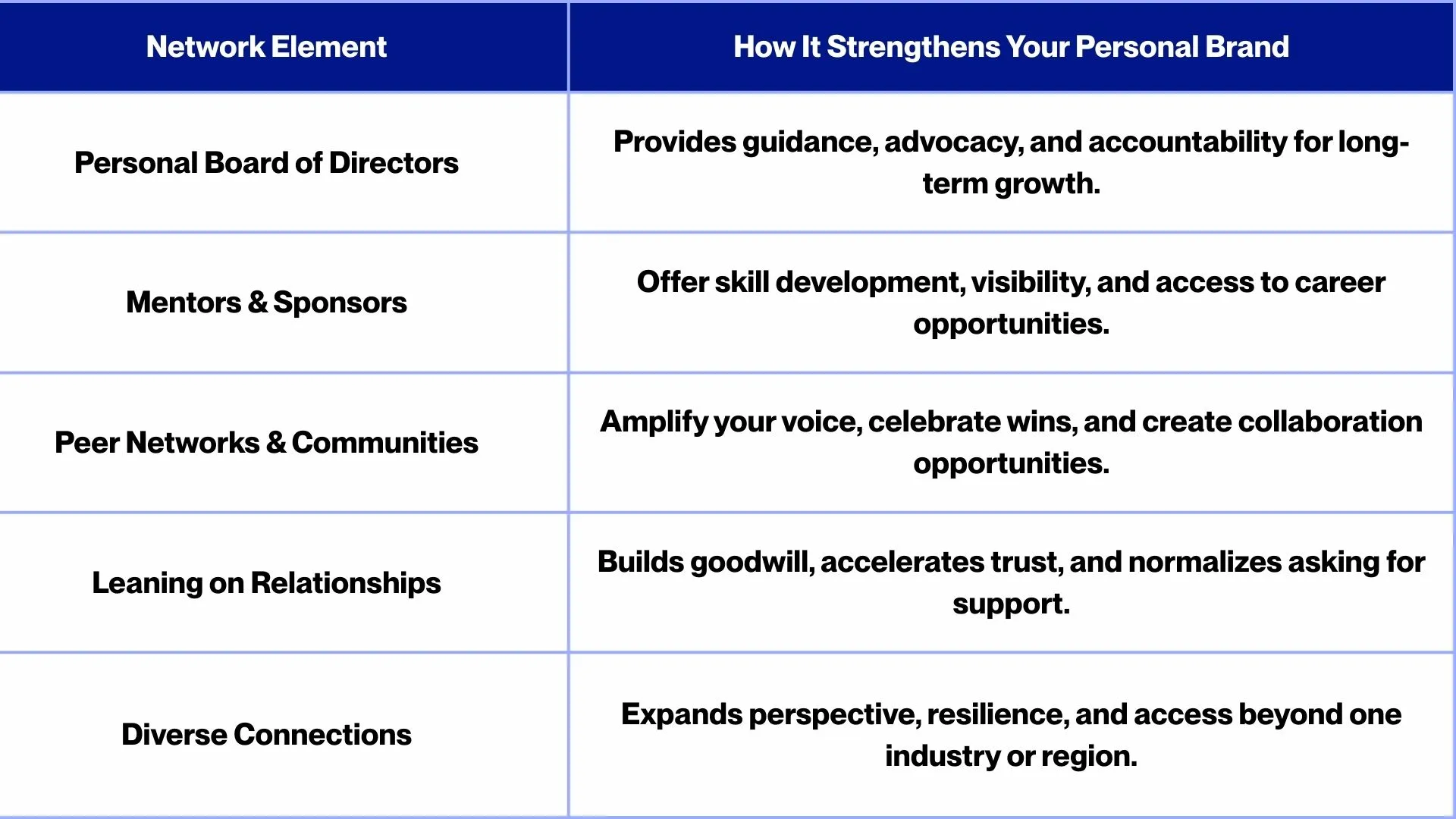
Personal branding is not done in isolation. In fact, some of the best brand building happens when you connect with and lean on others. Consider cultivating a personal board of directors—a group of mentors, peers, and sponsors who advise you, advocate for you, and keep you accountable to your goals. These are people who believe in you and will speak up on your behalf when you are not in the room. Surrounding yourself with such allies is especially important for women in finance, where networks have historically been crucial to advancement.
Mentors and Sponsors
Seek out mentors who can guide you in skills and sponsors who can push for your promotion. They could be women who have navigated similar paths or men who are advocates for female talent. Do not be afraid to ask someone you respect for a coffee chat to learn from their experience. When they get to know you, your competence becomes part of their brand too, and they might recommend you for opportunities. A strong personal brand can actually attract mentors. If you have been publicly vocal about a passion like increasing diversity in fintech, a leader who shares that passion might take notice of you and offer help.
Peer Networks and Communities
Join groups specifically for women in finance or broader professional communities. Sometimes these networks provide speaking or award opportunities that can elevate your brand. Organizations like Women in Banking or global forums host events where you can learn and gain visibility as a panelist or volunteer leader. Being an active member demonstrates leadership and commitment to the industry. Plus, peers can be great amplifiers who will engage with your posts, celebrate your wins, and invite you to collaborations. A strong network is one of the most powerful ways to amplify a personal brand.
Learn to Lean on Others
Often, women hesitate to leverage connections because they do not want to impose. Flip that thinking and consider that people generally like helping others. If you have built genuine relationships, do not shy away from reaching out, whether it is for an introduction to a firm or a quick endorsement on LinkedIn. Likewise, be ready to support others in their journey. Generosity is remembered and often returned. Over time, you will have a community that is invested in your success, and your brand will benefit from that goodwill.
Finally, diversify your network. It is valuable to have connections not just in finance, but in adjacent industries and various regions globally. These diverse ties can provide fresh insights and opportunities you might not find in your immediate circle. They also make your brand more resilient because you are not reliant on just one company’s ecosystem.
Align with Your Organization Without Getting Lost in It
For women working in finance, whether at a large bank, an asset management firm, or a fintech startup, there is a delicate balance to strike between your personal brand and your company brand. You want to be a team player who champions your organization’s values, but you do not want your identity to be completely subsumed by the company. Here is how to manage that balance effectively.
Be an Ambassador
Publicly align yourself with your company’s positive values and mission. This could mean sharing company news on LinkedIn with your personal take or speaking at conferences as a proud representative of your firm. By doing so, you amplify your influence and contribute to your firm’s success, and companies definitely take note of employees who boost their brand. For example, if your bank is pushing an initiative for financial inclusion and that resonates with you, incorporate it into your messaging. You will be seen as a leader who embodies the firm’s values, which can help your advancement internally and build goodwill externally.
Lean on Corporate Brand Equity
If you are part of a well-known institution, leverage its credibility while differentiating yourself. Clients or colleagues might initially know you through the company’s reputation, which opens the door, but you step through it by highlighting what makes you uniquely valuable. Maybe you are the analyst at a major firm who specifically specializes in green energy investments. The combination of company brand and personal niche makes you memorable. Use the firm’s platform to elevate your voice, perhaps by writing for the company blog. It is a symbiotic relationship: you boost the company image, and the company’s stature boosts yours. Just ensure that if you ever part ways, you have built enough of your own identity so that you remain a recognized expert in your own right.
Showcase Company Wins as Part of Your Story
If your organization has strong financial performance, use that in your narrative. Mentioning that working at a top-performing firm has shaped your approach subtly reinforces both the company’s brand and your own credibility. However, be clear about your own role in those wins. If you led a team that brought in new clients or increased assets under management, say so. Here, you tie your brand to the company’s financial success, which is a win-win for everyone involved.
Maintain Your Individual Identity
While you align with your employer, never forget to cultivate aspects of your brand that are independent. This could be your thought leadership on industry trends or your involvement in professional groups. The goal is that if you change jobs or start your own venture, your personal brand value travels with you. Clients and peers should recognize you for your expertise and values, which transcend any single employer. You are more than just a representative; you are an individual professional whose unique persona should shine through even as you wear the company jersey.
By balancing personal and corporate branding, you actually enhance both. You will shine as an individual while elevating your firm’s image, a combination that positions you as an indispensable asset in the financial world.
Personal Branding Tips for Financial Advisors and Client-Facing Women
While all finance professionals can benefit from personal branding, it is worth highlighting a few points for those in client-facing roles, such as financial advisors, planners, private bankers, or consultants. In these roles, your personal brand is tightly linked to client trust and business growth.
Emphasize Trust and Integrity
In surveys, investors often say trustworthiness is one of the top factors in choosing an advisor. Make sure your brand exudes integrity. This can be achieved through testimonials, consistent ethical behavior, or thought leadership that educates rather than sells. For example, you might share content about common financial mistakes and how to avoid them, demonstrating that you prioritize your clients' well-being. Your brand should answer the client’s unspoken question: Why should I trust you with my money? By being transparent, knowledgeable, and client-centric in your messaging, you build that trust. The finance industry lives on a foundation of trust, and people will only work with those they find credible.
Put Your Face and Personality Out There
People hire people, not firms. Especially if you are an independent advisor or part of a small team, your personal brand is the business brand. Do not hide behind a company name; let clients get to know you. Use a friendly, professional photo in marketing materials. Consider creating short videos or webinars where you talk about financial topics in simple terms to help clients feel like they already know you. Showing a bit of personality, such as mentioning your own experiences saving for college or retirement, can make you relatable. The goal is to create a trustworthy but approachable persona.
Consistency for Client Experience
Ensure every touchpoint a prospect or client has with you reinforces the same message and quality. From your LinkedIn profile to your business card and the way you conduct meetings, strive for a coherent experience. If your niche is holistic financial planning for young families, everything from your blog content to your seminar topics should reflect that focus. Every client interaction is a reflection of your brand. If you send a monthly newsletter, use it to consistently underscore your expertise and care. Over time, this builds a strong reputation that drives referrals.
Educate and Empower
Use your personal brand platform to educate clients and the public. This not only showcases your knowledge but also creates goodwill by providing value. A client who has been following your useful social media posts is already convinced of your expertise by the time they reach out. Many successful female financial influencers have built massive followings by freely teaching personal finance basics, which in turn bolstered their business. Whether through workshops, ebooks, or online Q&As, find a medium you enjoy and share your wisdom. It will differentiate you in a crowded market.
Leverage Testimonials and Impact
The finance industry has specific regulations about testimonials, so it is important to check your local rules. However, where allowed, a satisfied client’s story about how you helped them can be incredibly powerful. Even without formal testimonials, you can share general anecdotes about your impact, such as helping a client fund their children's education debt-free.
As a client-facing professional, your personal brand directly affects your bottom line. It is critical for winning and retaining clients over the long term. By building a brand centered on trust, expertise, and genuine care, you financially impact not just your career but also the significant life events of your clients. This is where the personal meets the financial in a very tangible way.
Embrace Your Story and Lead with Your Brand
Personal branding for women in finance is not a vanity exercise; it is a powerful form of career investment. Just as you would advise others to invest money to secure their future, investing time and effort into your personal brand pays dividends in the form of opportunities, recognition, and influence. It helps you show up with clarity, deepen your impact, and steer your career with intention. Like any investment, it grows over time when tended carefully.
Own Your Narrative
If you do not shape your brand, someone else will. Take ownership of your story and control how you are perceived by actively defining it. You have the power to highlight the qualities and achievements that you want to be known for. Do not leave it to others’ assumptions or to chance.
Be Patient but Persistent
Cultivating a strong brand does not happen overnight. It is a continuous practice of reflection, communication, and connection. You might start with small steps, a profile update, a new connection, or a single speaking engagement, and not see an immediate impact. However, over months and years, these efforts compound. Stay consistent and keep pushing forward, even when it feels like you are talking into the void. People are noticing, and opportunities will come.
Let Your Value Shine
Do not shy away from letting the world know what you are good at. As women, we sometimes downplay our brilliance. But think of your favorite female leaders in finance; they do not hide their light. They speak about what they care about and take pride in their work. You can do the same in your own style. Whether you are aiming to become a CFO, start a financial firm, or be the best analyst on your team, let your personal brand pave the way by showcasing the leader you are and the leader you are becoming.
The finance industry needs your voice and leadership. By building a personal brand that is authentic, visible, and strong, you are not only advancing your own career but also creating a ripple effect for other women and diverse voices to be heard. Step into the spotlight with confidence. The world needs to hear your story, beginning with the brand you build. It is time to make your mark and show everyone the powerhouse financial professional that you are.
Your journey starts now. Take these insights, apply the steps, and remember that every small action you take in service of your personal brand is an investment in yourself. You have something unique to offer in finance. Let it shine, boldly and unapologetically, through your personal brand. The results, both personally and financially, will be well worth it. Contact OhhMyBrand today to learn more about how to transform your name into a brand that opens doors. Let’s work together to make you not only visible but unforgettable in your field.



.svg)
.svg)
.svg)
.svg)



.svg)