


Personal Branding
8 Inspiring sample personal brand statement Examples
You have about seven seconds before someone decides whether you're worth their time. That's how long it takes to form a first impression and in 2025, that impression is often made long before you walk into the room. It happens on LinkedIn. On Google. On a conference bio page. The leaders who win aren't always the most talented; they're the ones who've mastered the art of saying the right thing, to the right people, in the fewest possible words. That's exactly what a great personal brand statement does. Whether you're a startup founder seeking Series A funding, a CEO building thought leadership, or a CTO stepping into the spotlight the eight frameworks below are your blueprint.
Discover Your Unique Value Proposition
In today's competitive market, standing out is essential whether you're a startup founder, an established CEO, or a leading CTO. Your personal brand is no longer optional; it's a critical asset. It represents your professional identity and the core message that sets you apart. At the center of a strong personal brand is a compelling personal brand statement, a concise expression of your unique value. According to LinkedIn's 2024 B2B Thought Leadership Impact Report, 89% of decision-makers say thought leadership improves their perception of an organization and it all begins with how you articulate who you are.
The way we communicate our values has changed. From traditional elevator pitches to modern Personal Brand Strategy Examples, the emphasis has shifted from simply describing what you do to showcasing the impact you make. An effective approach prioritizes authenticity, clearly articulates your strengths, and resonates with your target audience. Edelman's 2024 Trust Barometer confirms 63% of people trust a credible individual voice more than a corporate brand making your personal brand statement the single most powerful sentence in your professional toolkit.
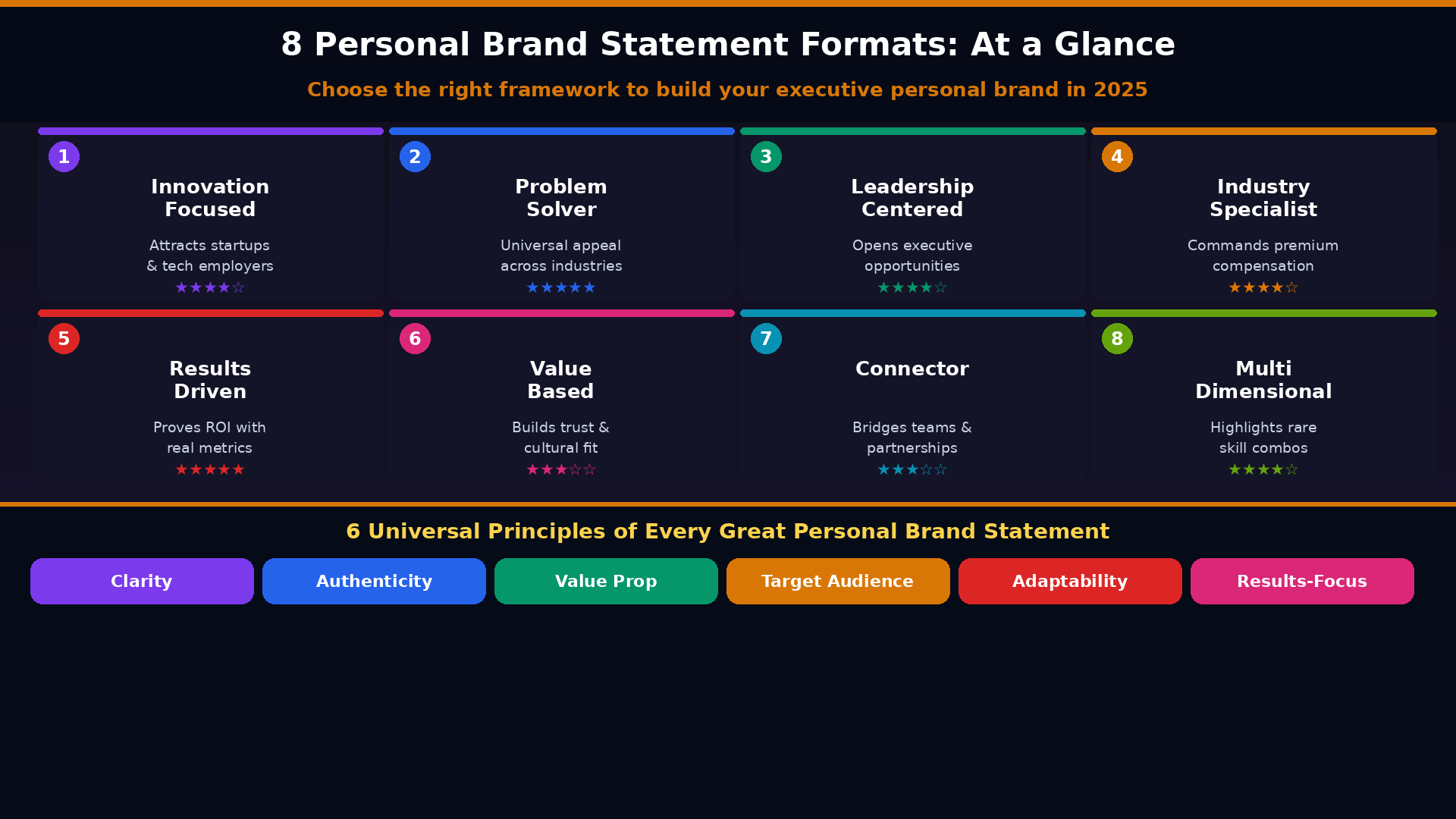
This article explores eight different types of personal brand statements designed for leaders. You'll learn how to pinpoint your core strengths, tailor your message for maximum effect, and create a statement that truly connects with your target audience. Whether you aim to secure funding, attract top talent, or become a recognized thought leader, mastering your personal brand statement is a vital step and central to any Brand Storytelling Framework.
1. Innovation-Focused Personal Brand Statement
For founders, entrepreneurs, CTOs, CEOs, and other corporate leaders especially in the startup world projecting an image of forward-thinking leadership is essential. An innovation-focused personal brand statement accomplishes this by emphasizing your ability to generate new ideas, challenge the norm, and drive meaningful change. This is the kind of statement that underpins Thought Leadership Strengthens Personal Brand because it positions you as a driver of progress, not just a participant. According to PwC's 2024 Global Innovation Survey, 61% of CEOs say innovation is a top three strategic priority your brand statement should reflect that.
Highlighting Innovation
This approach showcases your innovative thinking, creativity, and future-oriented perspective. It often uses terms related to transformation, disruption, and pioneering new methods. For example: "I transform complex data challenges into accessible insights that drive business growth through innovative visualization techniques" a statement that exemplifies Executive Personal Branding: Controlling Your Digital Narrative by leading with impact, not job title.
Benefits and Drawbacks
Benefits of an innovation-focused statement include:
• Sets you apart in traditional industries and attracts startups and tech companies
• Builds credibility in fast-changing sectors that value adaptability and forward-thinking
• Supports Personal Branding Trends Shaping 2025, particularly around AI-driven personalization and niche thought leadership
Potential drawbacks:
• May not suit traditional roles where established practices are critical
• Claims of innovation must be supported by concrete, measurable results to avoid seeming insincere
• Requires regular updates Gartner's 2024 Hype Cycle report notes that innovation narratives have a shelf life of 12–18 months
Examples of Innovation-Driven Brands
The effectiveness of this strategy is evident in figures like Elon Musk, known for his innovation-driven ventures; Steve Jobs, whose brand became synonymous with "thinking different"; and Arianna Huffington, who continually reinvented herself through innovative media and wellness approaches. These individuals exemplify how a commitment to innovation can significantly boost Build a Powerful Executive Brand.
Implementing an Innovation-Focused Approach
• Include specific innovations you've developed vague claims won't build credibility
• Quantify the impact of your innovative ideas whenever you can
• Use future-focused language while avoiding overused jargon
• Balance innovation claims with proven methodology Harvard Business Review notes that leaders who back innovation claims with data are 2x more trusted
2. Problem-Solver Personal Brand Statement
A Problem-Solver Personal Brand Statement focuses on your ability to tackle and resolve difficult problems. This approach highlights your analytical skills, practical thinking, and results-driven mindset. It presents you as a valuable resource capable of navigating obstacles and delivering effective solutions. This is one of the strongest Personal Brand Strategy Examples for leaders, founders, entrepreneurs, CTOs, and CEOs because problem-solving is the #1 skill employers seek in senior professionals, according to LinkedIn's 2024 Workplace Learning Report.
Pros of a Problem-Solver Statement
• Appealing to a wide range of employers problem-solving is universally valued
• Easy to illustrate with concrete examples and metrics, ideal for Personal Branding Case Studies
• Positions you as a key player in challenging situations
• Applicable across virtually all industries and job titles
Cons of a Problem-Solver Statement
• Can appear generic if specific problem domains aren't mentioned
• May not differentiate you in competitive fields where everyone emphasizes problem-solving
• Can appear tactical rather than strategic if metrics aren't tied to organizational goals
Examples of Problem-Solver Statements
• "I solve complex supply chain problems by identifying inefficiencies and implementing data-driven solutions that reduce costs while improving delivery times."
• "As a software engineer, I specialize in troubleshooting legacy systems and creating elegant solutions that extend their functionality."
• "I transform organizational conflicts into opportunities for team growth through systematic problem resolution frameworks."
Tips for Implementing a Problem-Solver Statement
• Specialize target a niche problem domain to be memorable rather than generic
• Describe your approach mention your process (data analysis, design thinking, specific frameworks) to build credibility
• Quantify your impact "Reduced customer support tickets by 20%" is more compelling than "Improved support performance"
• Balance technical and interpersonal problem-solving, especially in leadership roles
Figures like Ray Dalio, founder of Bridgewater Associates, Bill Gates, who focuses on solving global issues, and Marie Kondo, who built her brand around organization and decluttering, have all demonstrated the power of the problem-solver personal brand. This approach is valuable because it establishes credibility and demonstrates value particularly for those in leadership. McKinsey research shows that executives who lead with problem-solving narratives generate 3x more inbound business inquiries.
3. Leadership-Centered Personal Brand Statement
A Leadership-Centered Personal Brand Statement positions you as a leader capable of guiding teams, initiatives, or entire organizations toward success. It emphasizes your ability to inspire, make strategic decisions, and achieve collective goals. This type of statement is a cornerstone of Personal Branding for C-Level Executives and is especially relevant for those targeting leadership roles who want to showcase their ability to drive growth and positive change. According to Deloitte's 2024 Global Human Capital Trends Report, organizations with strong executive personal brands outperform peers by 20% in talent retention.
Features
• Focuses on leadership philosophy and approach
• Highlights the ability to motivate and develop others core to Thought Leadership Strengthens Personal Brand
• Emphasizes strategic vision and direction-setting
• Often includes references to team achievements and quantified outcomes
Pros & Cons
• Positions you for management and executive roles and demonstrates value beyond technical skills
• Attracts organizations seeking growth and direction, showing potential for increased responsibility
• Con: May appear presumptuous for early-career professionals without substantial leadership experience
• Con: Can overshadow technical or specialized expertise if not carefully balanced
Examples
• "I lead diverse technology teams to deliver innovative products by fostering a culture of experimentation and learning from failure."
• "As a healthcare administrator, I empower medical professionals through collaborative leadership that puts patient outcomes first."
• "I transform underperforming sales teams into market leaders by combining data-driven strategy with inspirational coaching."
Tips for Implementation
• Define your leadership style transformational, servant, or coaching-based?
• Quantify your achievements specify by how much and over what time frame
• Showcase development: did you mentor someone to a promotion? Implement a training program that upskilled the team?
• Balance authority and collaboration the best LinkedIn Post That Boosts Engagement from leaders shows both
Figures like Simon Sinek, known for his work on the "Why" in leadership, Sheryl Sandberg, who championed leadership principles and empowering others, and Richard Branson, whose personal brand is closely associated with inspirational leadership, have all contributed to this trend. LinkedIn's 2024 data shows leadership-focused executive profiles receive 2.5x more connection requests and speaking inquiries.
4. Industry Specialist Personal Brand Statement
This type of personal brand statement focuses on your deep expertise within a specific industry or domain. It positions you as the go-to authority within your niche a defining characteristic of the best Executive Personal Branding Agencies and Famous Personal Branding Experts. Edelman's B2B Thought Leadership study found 54% of C-suite executives use thought leadership to vet the organizations they work with making niche authority your most powerful competitive advantage.
Features and Benefits
• Demonstrates deep expertise and in-depth knowledge within a specific industry
• Attracts specific opportunities and positions you as a premium candidate
• Establishes Thought Leadership Examples presenting opportunities to influence industry conversations
• Commands higher compensation specialization leads to 25–40% salary premiums according to Mercer's 2024 Global Talent Trends Report
Pros and Cons
Examples of Industry Specialist Brand Statements
• "I leverage 15 years of pharmaceutical regulatory experience to guide companies through FDA approval processes, specializing in orphan drugs and expedited programs."
• "As a renewable energy finance specialist, I structure investment vehicles that maximize both environmental impact and investor returns."
• "I translate complex cybersecurity threats into actionable protection strategies for financial institutions navigating evolving compliance requirements."
Think of Warren Buffett, known for his investment expertise, or Anna Wintour, whose personal brand is intrinsically linked to the fashion industry. These individuals have cultivated recognition by focusing on specific areas of expertise, the very definition of Personal Branding Shapes Long-Term Reputation.
5. Results-Driven Personal Brand Statement
In the competitive business world, a results-driven personal brand statement can be a powerful tool. This approach highlights your proven ability to deliver measurable results and achieve objectives positioning you as a high-impact professional. Instead of listing duties, a results-driven statement focuses on outcomes and quantifiable value. This is a crucial component of any Executive Branding Influences Company Valuation strategy. According to Salesforce's 2024 State of Sales Report, executives who lead with metrics-backed narratives close deals 28% faster.
Key Features and Benefits
• Centers on measurable achievements and outcomes quantify your impact whenever possible
• Often includes specific metrics and percentages: "Increased sales by 15%" is more compelling than "Improved sales performance"
• Focuses on business impact rather than tasks performed the "why" behind your work, not just the "what"
• Connects personal contributions to organizational goals, showing alignment with the bigger picture
Examples of Results-Driven Statements
• "I drive e-commerce revenue growth of 30%+ annually by optimizing customer acquisition strategies and implementing data-driven retention programs."
• "As a project manager, I deliver complex IT implementations on time and under budget, with a 95% client satisfaction rating over 50+ projects."
• "I transform underperforming sales territories into top producers, consistently exceeding quotas by 25% through systematic prospecting and relationship development."
Pros and Cons
• Attracts results-oriented organizations and hiring managers and differentiates you from experience-focused candidates
• Highly effective in performance-driven industries like sales, marketing, and project management
• Con: Quantifying results can be challenging in some fields and may appear overly transactional
• Con: Requires consistent updates with new achievements to stay current
The focus on results-driven leadership has been promoted by influential figures like Jack Welch, former GE CEO, known for his emphasis on performance metrics, and Indra Nooyi, former PepsiCo CEO. Gary Vaynerchuk frequently highlights measurable business results as crucial to personal branding. A 2024 TopResume survey found that executives who invest in metrics-driven brand development report a 40% higher career earning trajectory.
6. Value-Based Personal Brand Statement
A Value-Based Personal Brand Statement focuses on your core values and ethical principles, showing how they shape your professional approach. It connects your work to a deeper meaning and purpose positioning you not just as skilled, but as someone whose values enhance their contributions. This is a powerful component of the Psychology Behind Effective Personal Branding because KPMG's 2024 Consumer Trust Survey found 86% of consumers want more transparency from executives about their values and decision-making.
Features
• Centers on personal values and ethical principles
• Connects professional work to a deeper meaning a core element of any Brand Storytelling Framework
• Emphasizes authenticity and consistency, essential to Build a Personal Brand Without Cringey LinkedIn content
• Often references social impact or contribution beyond profit
Examples
• "I design sustainable architecture guided by a deep commitment to environmental stewardship, creating spaces that honor both human needs and planetary boundaries." (Architecture)
• "As an HR professional driven by radical transparency and equity, I build workplace cultures where diverse talent can truly thrive." (Human Resources)
• "I develop healthcare technologies inspired by my belief that quality care is a human right, making medical innovations accessible to underserved communities." (Healthcare Technology)
Tips for Implementation
• Identify 2–3 core values, don't just pick buzzwords. Reflect on what truly motivates you
• Connect values to specific professional approaches: if integrity is a core value, how does that show in your project management style?
• Include concrete examples of how values translate to actions this is what separates genuine Personal Branding Case Studies from hollow claims
• Research potential employers to find value alignment a value-based statement is most effective when aimed at mission-driven organizations
Figures like Patagonia founder Yvon Chouinard, who built his brand around environmental values, Brené Brown, whose work centers on vulnerability and courage, and Howard Schultz, former Starbucks CEO, have popularized this approach. Edelman's 2024 Trust Barometer found that value-aligned leadership is now the #1 driver of executive credibility among global consumers.
7. Connector Personal Brand Statement
The Connector Personal Brand Statement emphasizes your ability to bring people, ideas, or resources together effectively. It positions you as a facilitator, a bridge-builder, and someone who creates synergy, a key component of Digital PR & Thought Leadership strategy. According to Deloitte's 2024 Human Capital Trends, organizations with strong internal connectors see 35% higher cross-functional innovation rates.
Features and Benefits
• Focuses on relationship-building and network development
• Highlights the ability to connect disparate ideas or groups core to LinkedIn Post That Boosts Engagement around collaboration topics
• Emphasizes collaboration and facilitation skills
• Works across industries and functions transferable and versatile
Pros & Cons
• Appeals to organizations needing internal or external collaboration and positions you well for stakeholder management roles
• Differentiates you in siloed organizations needing integration
• Con: May seem less substantial than technical statements in highly technical fields
• Con: Requires evidence of tangible outcomes simply stating you're a connector isn't sufficient
Examples
• "I bridge the gap between technical teams and business stakeholders, translating complex concepts into strategic value that drives organizational alignment."
• "As a business development specialist, I create partnerships across industries that transform competitors into collaborators and generate new market opportunities."
• "I connect creative talent with commercial opportunities, building relationships that translate artistic vision into viable business ventures."
Tips for Implementation
• Highlight specific relationships or connections you've facilitated with concrete examples
• Demonstrate the value created through your connecting activities did a partnership lead to increased revenue?
• Balance relationship focus with outcomes achieved
• Include diverse types of connections across departments, industries, or cultures
This approach has been popularized by influential figures like Reid Hoffman (LinkedIn founder), Keith Ferrazzi(author of "Never Eat Alone"), and Malcolm Gladwell. Their success demonstrates the power of building and leveraging connections. LinkedIn's own data shows that connector-type executives grow their networks 5x faster than those who lead with technical credentials alone a compelling case for this approach in building LinkedIn Branding for Executives.
8. Multi-Dimensional Personal Brand Statement
Having a diverse skillset is a major asset in today's professional world. A Multi-Dimensional Personal Brand Statement reflects this, showcasing a unique blend of professional identities and skills that might not typically go together. This approach positions you as someone with a distinct value proposition the very essence of Become Someone From No One in the personal branding landscape. David Epstein's research in Range: Why Generalists Triumph in a Specialized World supports this approach: generalists with multi-disciplinary expertise are increasingly preferred for complex, ambiguous leadership roles.
Features
• Highlights unusual skill combinations coding and culinary arts, finance and philosophy, engineering and writing
• Emphasizes versatility and adaptability demonstrates your ability to move between domains
• Connects seemingly disparate fields shows capacity for interdisciplinary thinking
• Frequently uses "and" statements to link skills, creating a memorable Personal Brand Strategy Examples signature
Pros & Cons
• Sets you apart from individuals with traditional backgrounds and attracts organizations with complex challenges
• Opens doors to unique roles and creates a memorable brand
• Con: Risk of appearing unfocused if the skill combination appears random or lacks a clear connection
• Con: Could impact visibility in recruiter searches that rely on standard keywords a challenge for SEO Consultant-style personal brand optimization
Examples
• "I combine data science expertise with strong communication skills to translate complex data into actionable insights that drive business decisions."
• "As a certified project manager and experienced photographer, I bring a unique blend of organizational skills and creative vision to every project."
• "I integrate financial modeling with a deep understanding of social impact to develop investment strategies that generate both financial returns and positive social change."
Tips for Implementation
Clearly articulate the synergy explain how your diverse skills complement and strengthen one another
Emphasize your unique value: how does your particular combination create a distinct advantage?
Target the right audience organizations that value interdisciplinary thinking and unconventional approaches
Prepare specific examples where your multi-dimensional perspective delivered positive outcomes
The importance of multi-disciplinarity has been highlighted by David Epstein, Brian Grazer, and Oprah Winfrey whose empire spanning media, wellness, education, and entrepreneurship demonstrates the impact of a multi-dimensional personal brand. McKinsey's 2024 Future of Work report finds that multi-disciplinary leaders are 1.7x more likely to be promoted to C-suite roles than those with purely specialized backgrounds.
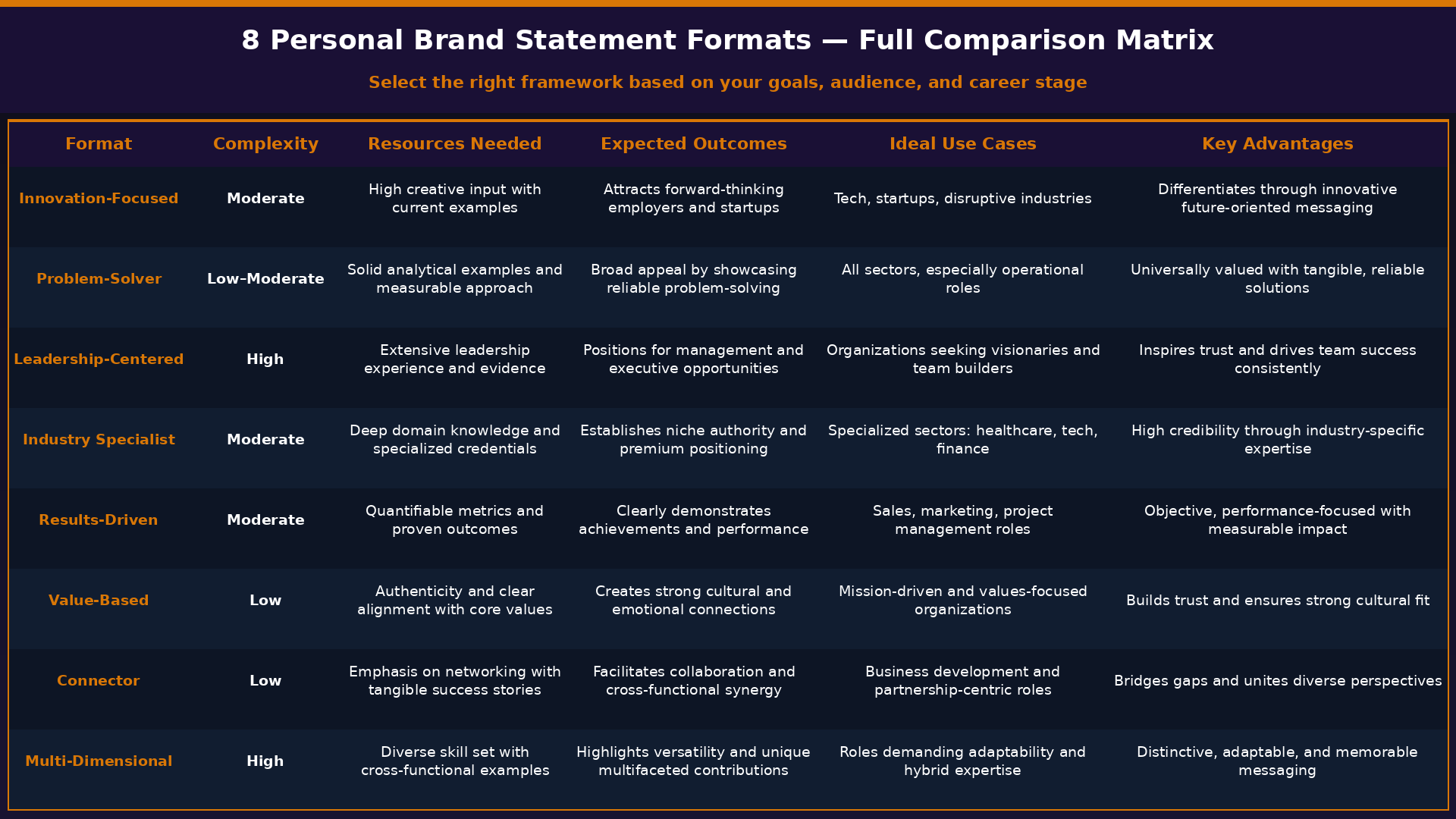
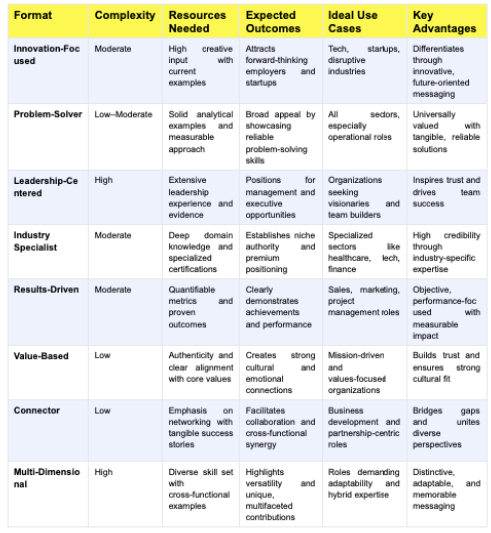
8-Format Comparison: Sample Personal Brand Statements
The table below summarizes all eight formats side by side, a quick reference for choosing the right Personal Brand Strategy Examples approach for your goals, audience, and career stage.
Craft Your Winning Statement
Crafting a compelling personal brand statement is a journey of self-discovery and strategic positioning. The key is to create a statement that authentically reflects your unique value proposition while resonating with your target audience. Remember the core principles: clarity, conciseness, authenticity, and a focus on the value you bring. According to Sprout Social's 2024 Social Index, authentic executive content gets 3x more shares and 2x more direct messages than promotional content making authenticity non-negotiable.
Identifying your core strengths, values, and desired impact is the first step. Think about your unique skills and experiences. What problems do you solve? What solutions do you offer? Weave these elements into a concise and memorable statement that encapsulates your brand essence, the foundation of any effective Brand Storytelling Framework and Personal Brand Strategy Examples you'll create.
Personal branding isn't static; it requires continuous learning and adaptation. Stay updated on Personal Branding Trends Shaping 2025, observe the evolving landscape of your field, and refine your statement as you grow. Authenticity and genuine connection are increasingly important to ensure your statement remains true to you, and remember that Personal Branding Shapes Long-Term Reputation over time, not just in the moment.
Key Takeaways
Clarity: Ensure your statement is easily understood and memorable. Could a stranger read it and immediately know your value?
Authenticity: Your statement should reflect your true self and values Build a Personal Brand Without Cringey LinkedIn starts with being genuine
Value Proposition: Articulate the benefits you provide clearly this is the core of all Personal Brand Strategy Examples
Target Audience: Tailor your message to resonate with your intended audience LinkedIn research shows audience-tailored profiles receive 5x more relevant connection requests
Adaptability: Be prepared to refine your statement as you grow and evolve Personal Branding Trends Shaping 2025 demand regular updates
Ready to build a personal brand that commands attention and elevates your influence? Ohh My Brand helps founders, CEOs, and entrepreneurs create powerful personal brands that get noticed. Explore personal branding websites to understand what works, or discover the best personal branding consultants shaping the industry. Their team of LinkedIn Personal Branding Experts develops engaging content, secures media coverage, and amplifies your online presence to establish authority and build lasting impact. Whether you’re evaluating the best linkedin profile optimization services companies, comparing executive personal brand agencies, or researching personal branding agencies on linkedin, Ohh My Brand delivers. Visit Ohh My Brand today to discover how they can help you achieve your branding goals.


.svg)
.svg)
.svg)
.svg)



.svg)