


Personal Branding
The Ultimate Guide to Personal Branding for CEOs in 2026 (Updated)
Two CEOs. Same industry. Same size company. Same product quality. One becomes the name everyone cites at conferences, the benchmark investors reference, the thought leader journalists call for quotes. The other stays invisible anonymous behind a corporate logo while their competitor shapes the entire industry narrative. The difference is rarely strategy, funding, or even talent. It's a personal brand. In 2025, the leaders who win hearts, deals, and talent are the ones who've stopped waiting for permission to be known and started deliberately building the most powerful asset in their professional toolkit: themselves.
In today's hyper-connected world, a CEO's personal brand can be a make-or-break asset. The digital landscape of 2025 has heightened transparency and stakeholder expectations: customers, employees, and investors all want to see the person behind the company. If you're a CEO or founder struggling to stand out in a crowded market, the truth is: not taking charge of your narrative is the greater risk.
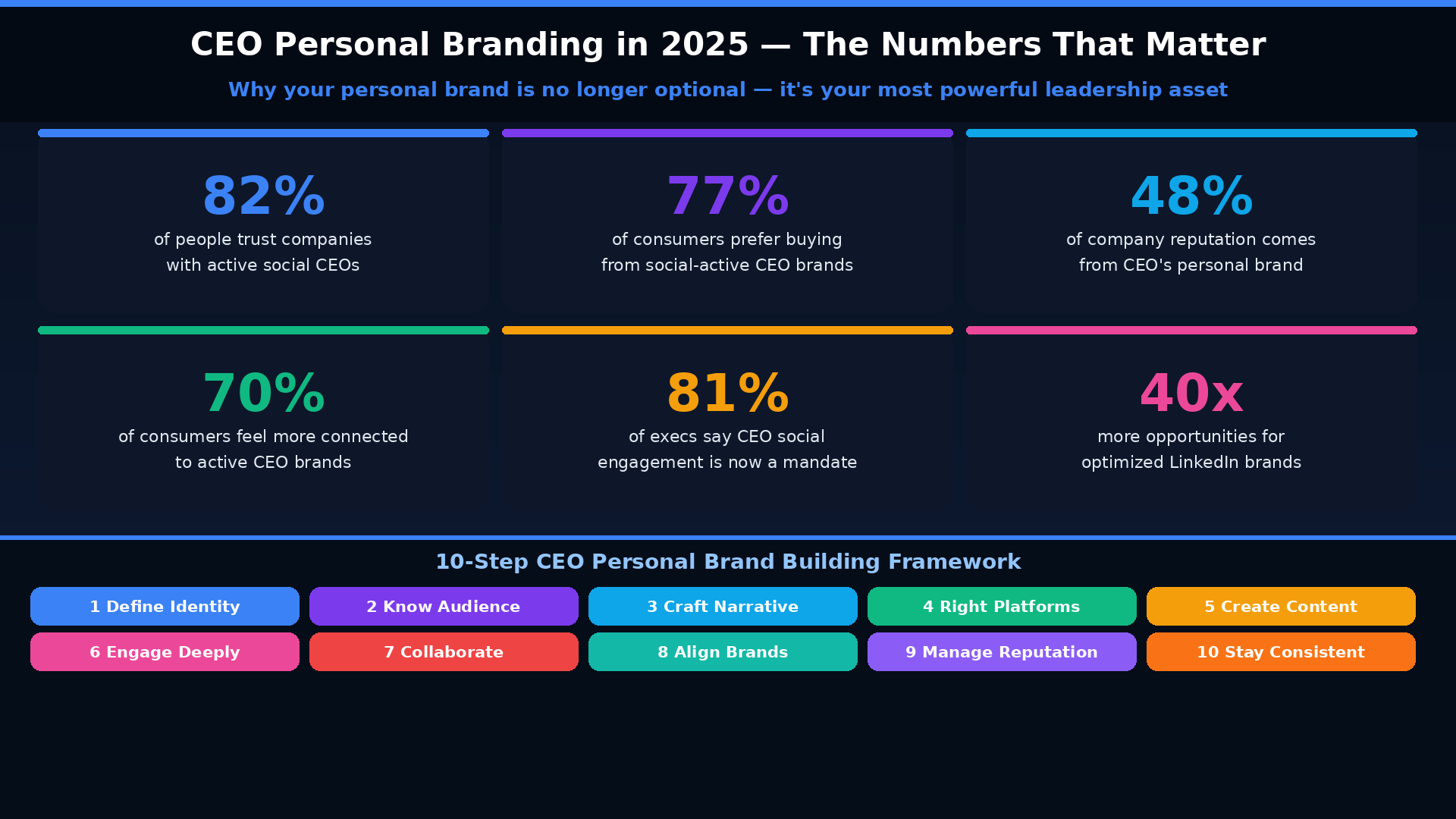
82% of people are more likely to trust a company whose senior executives are active on social media, and 77% of consumers are more likely to buy from a company when its CEO uses social media. These aren't marginal advantages, they're business imperatives. As Amazon founder Jeff Bezos famously said, "Your brand is what people say about you when you're not in the room." For modern CEOs, your personal brand isn't a vanity project it's a leadership responsibility. Nearly 48% of a company's reputation is directly attributable to the CEO's personal brand, making Executive Branding Influences Company Valuation one of the most under-leveraged growth levers available.
This Ultimate Guide will walk you through step-by-step strategies to Build a CEO Personal Brand on LinkedIn in 2025 and across every relevant platform. We'll cover everything from defining your unique value to mastering LinkedIn Branding for Executives, creating Thought Leadership Examples, and managing your reputation. By the end, you'll know exactly how to craft a personal brand that boosts your credibility, amplifies your influence, and propels your business forward with the tools to start doing it right away.
Why Executive Branding Is Essential in 2025: The Business Case
In 2025, Executive Branding Is Essential in 2025 not optional. The corporate world has learned that people connect with people, not logos. Research from Edelman's 2024 Trust Barometer shows 81% of global executives believe CEO engagement on social media is now a mandate for building company reputation. When you, as a CEO, put a face and voice to your company's values, you humanize the business and humanization is what converts trust into revenue.
Trust and Transparency
We live in a time of radical transparency and digital scrutiny. Stakeholders demand authenticity from leadership. A lack of personal presence can signal a red flag as personal branding expert Chris J. 'Mohawk' Reed warns, "If I Google you and nothing comes up, that's a red flag." A personal brand today is often more important than your résumé or credentials. According to LinkedIn's 2024 Economic Graph Report, executives with optimized personal brands are 40x more likely to receive inbound opportunities the data makes Executive Personal Branding: Controlling Your Digital Narrative a non-negotiable priority.
Impact on the Bottom Line
A strong CEO brand isn't just about image it delivers tangible business results. In a recent Sprout Social study, 70% of consumers felt more connected to brands whose CEOs are active on social media, with over half saying they'd spend more with those companies. Your personal brand becomes a magnet for business opportunities, partnerships, and loyal customers, the core promise of Build a Powerful Executive Brand.
Leadership in the Spotlight
Today's CEOs are expected to be thought leaders and public figures in their own right. A well-crafted personal narrative helps you control your story in both good times and bad. A CEO with an established personal brand enjoys a crisis management advantage having direct channels to communicate and built-up goodwill means stakeholders are more likely to give you the benefit of the doubt. Thought Leadership Strengthens Personal Brand equity, and that equity pays dividends precisely when you need it most.
Talent and Culture Building
Personal branding also matters internally. Employees are more engaged and motivated when they feel connected to a real person at the helm. Deloitte's 2024 Global Human Capital Trends Report found organizations with strong executive personal brands outperform peers by 20% in talent retention. A CEO who shares their values and vision publicly can inspire teams and attract top talent transforming a faceless corporation into a relatable organization led by someone people trust.
Key Benefits of a Strong CEO Personal Brand in 2026
• Enhanced Trust & Credibility: A visible and authentic CEO personal brand significantly boosts trust. Satya Nadella, CEO of Microsoft, revitalized the company's image by championing a 'growth mindset' culture and openly discussing digital transformation his Thought Leadership Examples helped Microsoft regain its status as a tech leader. Edelman's Trust Barometer confirms trust in the leader directly spills over to trust in the business.
• Greater Visibility & Influence: A strong personal brand exponentially increases your reach. Richard Branson leverages social media to showcase his personality his adventurous, charismatic posts have made him globally recognized, amplifying the Virgin brand far beyond traditional advertising. LinkedIn reports executives with strong personal brands get significantly higher engagement, reaching audiences far beyond their company's follower base.
• Humanized Leadership: In an era that values transparency, your personal brand humanizes your leadership. Mary Barra, CEO of General Motors, has used her personal voice to advocate for innovation and sustainability making her leadership more relatable to employees and customers alike. When your personal values amplify your company's values, it creates a cohesive and compelling narrative.
• Business Growth & Opportunities: A well-known CEO can be a powerful growth engine. Elon Musk's personal brand has been a massive asset to Tesla and SpaceX his communications generate media coverage that marketing budgets can't match. More broadly, 77% of consumers say they'd rather purchase from a company whose CEO is active on social media, demonstrating that Executive Branding Influences Company Valuation in measurable, commercial terms.
• Crisis Resilience: When challenges arise, a CEO with an established personal brand has a reservoir of trust to draw upon. Consistency and credibility equal crisis insurance. According to PwC's 2024 CEO Survey, 83% of CEOs say their personal brand directly impacts their company's ability to navigate reputation-threatening events build the brand before you need to draw on it.
Personal Branding vs Corporate Branding
Many executives ask: "I already have a company brand, why do I need a personal one?" Personal branding vs corporate branding isn't an either/or scenario, it's about balance and alignment. Think of it as a perfectly choreographed dance: your personal brand and your company's brand should move in sync, each enhancing the other. Lucidpress's 2024 Brand Consistency Report found consistent brand presentation across personal and corporate channels increases revenue by up to 23% the synergy effect is real and measurable.
Distinct but Complementary: Your personal brand is you your values, personality, expertise, and leadership style. Tesla's brand is about innovation and bold vision, and Elon Musk's personal brand amplifies that image with his futuristic goals. Mismatch creates audience confusion; alignment creates a multiplier effect that neither brand could achieve alone.
Authenticity and Alignment: Identify the overlapping space between your personal values and your company's values that's your sweet spot. When Mary Barra speaks about innovation and diversity, it aligns perfectly with GM's push toward electric vehicles and inclusive culture. Her personal convictions bolster GM's credibility in those areas, demonstrating how Brand Strategy works best when personal and corporate narratives are intertwined.
Avoiding Brand Conflict: Be mindful not to conflict with your corporate brand. Strategic judgment, not self-censorship, is the key. You can be authentic and bold; just remember you wear two hats: individual and company representative. Gartner's 2024 CMO Spend Survey found 72% of marketing leaders consider executive personal branding a top-priority strategic investment precisely because the stakes of misalignment are so high.
The Power of Unity: When done right, personal and company brand create a multiplier effect a seamless narrative that is doubly compelling. The era of distant, voiceless chief executives is over. Don't hide behind your logo. Today's great leaders become the living personification of their company's mission which is exactly what Executive Personal Branding Agencies help you achieve.
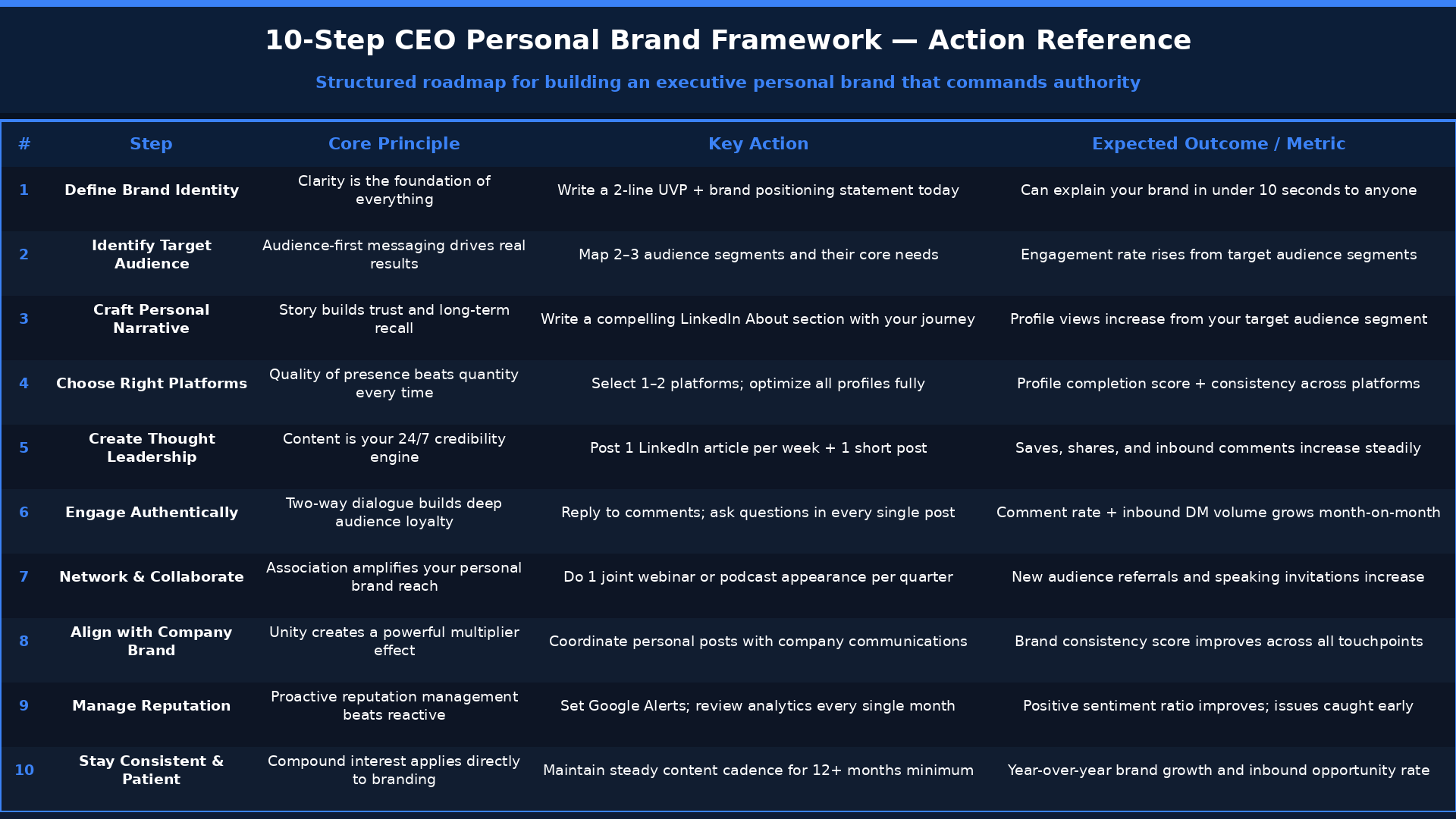
Step-by-Step Guide: Build a CEO Personal Brand on LinkedIn in 2025 10-Step Framework
Developing a Personal Branding for C-Level Executives strategy can feel daunting, but it breaks down into manageable, sequential steps. Think of it as developing a strategy for Brand You with the same intentionality you'd apply to any major business initiative. LinkedIn's 2024 B2B Thought Leadership Impact Report found 89% of decision-makers say thought leadership increases their trust in an organization every step below is designed to help you achieve exactly that.
Step 1: Define Your Brand Strategy Identity Your Why, Values & UVP
The foundation of any strong personal brand is clarity. Before you post a single thought or publish an article, take a step back and define who you are as a leader. This is the brand discovery phase the most critical and most frequently skipped step in Personal Branding for C-Level Executives. Ask yourself: What do I want to be known for? Identify your core values, beliefs, and leadership philosophy.
Next, articulate your unique value proposition (UVP) as a leader the promise of value that you bring to the table. What unique combination of skills, experience, and perspective do you have that others don't? Your UVP is your professional DNA. Brainstorm a concise statement: "Tech CEO who marries data-driven strategy with empathetic leadership" or "Finance leader passionate about ethical investing and inclusion." This clarity will guide your entire Brand Strategy like a north star.
Remember: Authenticity is non-negotiable. Your brand identity must be true to who you are, or it will ring hollow. Edelman's 2024 Trust Barometer confirms audiences can spot inauthenticity almost instantly 63% say they stop trusting a leader the moment they detect manufactured messaging. Define your story if you don't, others will define it for you.
Step 2: Identify Your Target Audience for Your Executive Personal Branding Agencies-Level Messaging
Just as in business, knowing your target audience is vital for personal branding. As a CEO, your audiences might include customers, industry peers, investors, current and future employees, and the media. Get clear on which groups matter most to your goals. LinkedIn's 2024 data shows targeted executive content receives 5x more engagement than generic professional posting audience specificity is a multiplier, not a constraint.
Take a cue from Dr. Ilham Kadri, CEO of Solvay, the first woman to lead a major chemical company who built her personal brand around sustainability and inclusion. Her audience spans business leaders, the scientific community, and women in STEM, and she tailors her message to speak to all those groups without losing a consistent voice. Personal Brand Strategy Examples like hers demonstrate that audience clarity doesn't require a different persona, just a different emphasis and context.
Step 3: Craft Your Personal Narrative The Brand Storytelling Framework for CEOs
Human beings are wired for stories, and your journey as a leader is one of your most powerful branding assets. Rather than presenting yourself as a collection of titles and achievements, shape a narrative that ties together your experience, passions, and purpose this is the foundation of an effective Brand Storytelling Framework. Include pivotal moments in your career that defined your values or taught you key lessons. These elements make you relatable and memorable.
Start by developing a compelling bio or 'About Me' story for your LinkedIn About section, personal website, and speaker introductions. It should read less like a dry résumé and more like a journey. Highlight the "why" behind what you do: Why did you start or join this company? Why are you passionate about this industry? One tip: keep it benefit-driven for the reader; it's your story, but framed in a way that offers insight or inspiration to others.
Don't shy away from showing personality and even a bit of vulnerability where appropriate it makes you human. Authenticity is magnetic. Sprout Social's 2024 Index shows authentic storytelling-led content generates 3x more shares than promotional messaging. The principle: shape the narrative, or someone else will and they rarely tell your story as well as you can.
Step 4: Choose the Right Platforms Make Your LinkedIn a Personal Brand Magnet and Beyond
Not all platforms are created equal for executive branding. For most CEOs and founders, the non-negotiable platform is LinkedIn, your digital business card, networking lounge, and publishing platform all in one. Ensure your profile is fully optimized: a professional headshot, a headline that goes beyond your title, and an 'About' section that tells your story. Make Your LinkedIn a Personal Brand Magnet by posting regularly, writing articles, and commenting on industry discussions. Executives who actively share content on LinkedIn are perceived as more trustworthy by stakeholders Microsoft CEO Satya Nadella regularly publishes posts engaging nearly 10 million followers.
Beyond LinkedIn, consider Twitter (X) for real-time commentary and connecting with media and influencers. If your strengths lean toward spoken or visual content, platforms like podcasts, YouTube, or Instagram might play a role. Many executives start newsletters on Substack or Medium a great way to regularly communicate your thoughts in a controlled format. LinkedIn's 2024 data shows profiles optimized by professional consultants receive 21x more views than self-managed profiles making LinkedIn Branding Experts investment a measurable ROI decision.
Important: you do not need to use every platform. Pick one or two where you'll find your audience and feel most comfortable then do them with excellence. Maintain consistency across all profiles: same professional headshot, similar descriptions, and a cohesive tone. Consistency breeds familiarity and trust the building blocks of LinkedIn Branding for Executives authority.
Step 5: Create Valuable Content and Thought Leadership Examples That Resonate
Content is the fuel of your personal brand engine. By creating and sharing valuable content, you demonstrate expertise and give people a reason to follow and trust you. The key word is "valuable" content that is useful, insightful, or inspiring to your target audience. This is how you move from just being visible to being influential. Thought Leadership Strengthens Personal Brand equity over time, compounding with every post, article, and speaking engagement.
Start by deciding on a few core themes you'll regularly address tied to your expertise and relevant to your business. Choose content formats that suit you: blog posts and LinkedIn articles if you enjoy writing, podcasts or video series if you prefer speaking. Mix content types: thought leadership articles, how-to advice, personal anecdotes, behind-the-scenes looks, and curated content with your commentary. Bill Gates' personal blog, Gates Notes, is one of the most cited CEO thought leadership examples his thoughtful essays have enhanced his personal brand as a global thinker and philanthropist.
Aim for consistency over frequency. A realistic schedule one LinkedIn article per month, one shorter post per week is better than sporadic bursts of content. LinkedIn's 2024 data shows profiles that post consistently receive 5x more views than those that don't. Quality matters too: before publishing, ask "Does this provide value?" Every piece of content should offer a fresh insight, a useful tip, or a provocative question that gets people thinking. These are the Thought Leadership Examples that build credibility and create a digital footprint that works for you 24/7.
Arianna Huffington writes and curates content around wellness and productivity on her platforms, consistently reinforcing her brand as a wellness advocate. According to HubSpot's 2024 State of Marketing Report, consistent thought leadership content generates 3x more qualified leads per year than promotional content the ROI of a Digital PR & Thought Leadership strategy is measurable and compelling.
Step 6: Engage Authentically Build a Personal Brand Without Cringey LinkedIn Content
Building a personal brand is not a 'broadcast-only' activity. One of the greatest advantages of social media is the ability to engage in two-way conversations turning a monologue into a dialogue. That's where relationships and reputations are truly forged. The goal is to Build a Personal Brand Without Cringey LinkedIn content authentic engagement that feels natural, not performative.
• Be accessible (within reason): Make it a habit to respond where it matters. A quick personal reply from a CEO can leave a strong positive impression. Show your human side: people know you're busy, but genuine engagement sets you apart from invisible leaders.
• Build a community: Think of your followers as a community you're fostering. Encourage discussion by asking questions: 'What do you think about X trend?' or 'Has anyone else experienced Y challenge?' Over time, this community becomes a tribe of advocates who amplify your content a LinkedIn Post That Boosts Engagement strategy that compounds over months.
• Show empathy and personality: Authentic engagement means letting personality shine through rather than always sticking to corporate-speak. Such interactions remind people there's a real person behind the CEO title which deepens trust and builds the Psychology Behind Effective Personal Branding equity that distinguishes great leaders.
Sprout Social's 2024 Index shows that CEOs who engage authentically on social media generate 2x more audience loyalty than those who only broadcast content. Consistent engagement builds reputation by association people start to feel a connection, and that connection drives everything from sales to talent acquisition.
Step 7: Network and Collaborate Executives Can Build a Strong Personal Brand Through Association
Even as you build your own platform, don't underestimate the power of leveraging other networks and partnerships. Collaboration can rapidly amplify your personal brand by tapping into new audiences and adding credibility by association a core principle of how Executives Can Build a Strong Personal Brand beyond their immediate orbit.
• Engage with fellow thought leaders: Identify other voices in your industry with strong personal brands. Could you do a joint webinar, podcast, or panel? When two respected figures have a conversation, both brands benefit from each other's audiences. LinkedIn data shows collaborative content receives 40% more reach than solo posts.
• Mentorship and community involvement: Offer to guest speak at industry events or conferences. By positioning yourself as someone who contributes knowledge to the broader community, you gain respect and visibility. Sheryl Sandberg built a significant aspect of her personal brand by co-authoring with Adam Grant and collaborating with organizations promoting women in leadership reinforcing her identity as a Thought Leadership Examples advocate.
• Attend and host events: Speaking at conferences or events immediately boosts credibility. Live-tweeting insights from major industry events, tagging other attendees, and hosting your own executive roundtable can position you as a connector and leader in the space.
Warren Buffett bolsters his personal brand via his famed annual shareholder meetings and network of mentees. McKinsey's 2024 research finds multi-disciplinary leaders who actively collaborate are 1.7x more likely to be promoted to or retain C-suite positions. Don't go it alone the more you engage and uplift others, the more your own brand is strengthened.
Step 8: Align Your Personal Brand with Your Company's Executive Branding Influences Company Valuation Most at This Stage
Make sure your personal branding efforts are in harmony with your company's branding and messaging. As CEO, you are the face of the company consistency between what you say and what your company says is paramount. This is where Executive Branding Influences Company Valuation most directly: Edelman's research shows that 61% of people are more likely to buy from a company whose CEO has an active, consistent personal brand that aligns with the organization's stated values.
Reinforce company values: Use your personal platform to highlight your company's mission, vision, and values but in a personal way. Share stories of how those values guide your decisions. When your personal brand stories echo the company's core values, it creates a reinforcing loop that strengthens both reputations simultaneously.
Showcase company wins and team highlights: As part of your content mix, celebrate your company's achievements through your personal channels. Spotlight your team. This signals to employees that you see your personal platform as a means to uplift the whole organization critical for internal buy-in and employer brand strength.
Be careful with controversial stances: Many stakeholders expect CEOs to speak out on social issues done thoughtfully and authentically, it can greatly strengthen your brand. PwC's 2024 CEO Survey found purpose-driven leadership is now the #1 driver of executive credibility among millennial consumers and employees. But it must be approached with coherence: align it with your company's values or it may ring hollow.
Remember: any misalignment will be quickly noticed. Audiences in 2025 are savvy and will call out dissonance think of times when a CEO's personal actions contradicted the company's stated values. Always double-check that Brand You and Brand Company are marching to the same drumbeat. When they do, you create a cohesive leadership brand that magnifies trust in both the ultimate expression of Executive Personal Branding: Controlling Your Digital Narrative.
Step 9: Manage Your Reputation Proactively Executive Online Reputation Management Agencies and DIY Tools
Building your personal brand is not a one-and-done project it requires ongoing maintenance and adaptation. As your visibility grows, so will feedback and scrutiny. Whether you manage this yourself or partner with Executive Online Reputation Management Agencies, proactive reputation management is essential. According to BrightLocal's 2024 Consumer Review Survey, 87% of consumers read reviews before making decisions and 79% trust personal recommendations as much as professional reviews. Your digital footprint is always on, so your management of it should be too.
• Monitor your online presence: Set up Google Alerts for your name and your company. Regularly check social media mentions and tags. Many CEOs enlist their communications team or use professional tools for social listening the goal is to avoid being blindsided by a developing conversation or issue.
• Respond to negative feedback wisely: If someone posts a valid criticism, consider addressing it head-on in a polite, solutions-oriented manner. Acknowledge valid points and share what you're doing. Transparency is powerful in earning respect. However, if you encounter obvious trolling or bad-faith attacks, it's often best not to engage directly.
• Use metrics to gauge impact: Track follower growth, engagement rates, speaking invitations, and media quotes. If certain topics or formats resonate more, lean into those. Regularly review what's working and what's not and adapt your strategy accordingly.
• Professional reputation management: If you're a high-profile leader, consider having a reputation management plan or support. Executive Online Reputation Management Agencies can help proactively share positive news, pitch op-eds, apply for recognitions, and monitor Wikipedia and other references for accuracy.
Your personal brand is an asset that needs care. By staying vigilant and adaptable, you ensure that your brand keeps growing positively and can weather any storms. Gartner's 2024 CMO Spend Survey found 72% of marketing leaders now consider executive personal branding a top-priority long-term investment proactive reputation management is how that investment is protected.
Step 10: Be Consistent, Patient, and Bold Personal Branding Shapes Long-Term Reputation Through Compound Growth
Last but not least: recognize that building a formidable personal brand takes time. Every great personal brand like every great company was built over years, not weeks. Persistence and consistency will set you apart because many people simply give up too soon. Personal Branding Shapes Long-Term Reputation through compound interest each article, each speaking gig, and each genuine interaction accumulates into an overall perception of you. LinkedIn's 2024 data shows consistent executive posting for 12+ months produces exponentially better engagement outcomes than short bursts of activity.
Keep a steady cadence: Consistency beats frequency. It's better to post valuable content once a week than fluff every day. Over 6–12 months, you'll notice your audience and impact growing. People will start quoting you, the media will reach out, and invitations will come. Trust the process.
Be boldly authentic: Authenticity remains the bedrock of a powerful personal brand. As Personal Branding Trends Shaping 2025 make clear, audiences crave genuineness. Show your growth, share new insights, and even admit past mistakes if relevant it humanizes you and keeps your story real.
Embrace innovation: Keep an eye on emerging branding tactics. A few years ago, CEOs who started doing LinkedIn Live early got outsized attention. In 2025, experimenting with short-form video or AI-powered content personalization might be the equivalent. Don't jump on every bandwagon but if something aligns with your style and audience, early adoption signals forward-thinking leadership.
Consistency + Authenticity + Time = Brand Success. One day, you'll notice that you're the one people cite, that your name comes up in industry conversations as the Thought Leadership Examples benchmark that's the payoff. Stay patient, keep at it, and remember: your personal brand isn't just a marketing vehicle. It's a reflection of your growth as a leader and a chance to shape your legacy. Personal Branding Shapes Long-Term Reputation and in 2025, that reputation is your most enduring competitive advantage.
Feeling overwhelmed or unsure where to start with your CEO brand? Book a free personal branding audit with the team at Ohh My Brand. They'll analyze your current online presence and offer tailored, actionable steps to elevate your leadership brand no strings attached. Get clarity and a game plan in a 30-minute session so you can build your brand with confidence.
Personal Branding Trends Shaping 2025 What CEOs Need to Know Now
The world of personal branding continues to evolve. Staying ahead of Personal Branding Trends Shaping 2025 can give you a significant edge. Here are the emerging trends CEOs and executives should prioritize:
• Short-Form Video Dominance: TikTok, Instagram Reels, and YouTube Shorts have become popular channels for bite-sized thought leadership. CEOs are using short videos to share quick tips or insights in a more engaging, personable way. HubSpot's 2024 State of Marketing Report found video content generates 66% more qualified leads per year than text-based content expect more leaders to experiment with casual, selfie-style videos to communicate.
• AI-Powered Personalization: AI is changing how content is created and delivered. Savvy executives leverage AI tools to personalize their outreach at scale analyzing which topics resonate most, suggesting optimal posting times, and helping draft tailored messages for different audience segments. Salesforce's 2024 State of Marketing Report found AI-personalized content strategies outperform generic approaches by 72% but always add your human touch to maintain the authenticity that Psychology Behind Effective Personal Branding demands.
• Purpose-Driven Branding & CEO Activism: The expectation for leaders to take stances on social, environmental, and governance issues is higher than ever. CEOs who boldly align with causes tend to build passionate followings. Edelman's 2024 Trust Barometer shows purpose-driven personal branding is now the #1 driver of executive credibility among consumers under 40. Done thoughtfully, this advocacy greatly amplifies your brand just ensure authenticity.
• Internal Branding and Employee Advocacy: Forward-thinking CEOs in 2025 actively encourage and shape employee advocacy on social media. By empowering your team to share their experiences and thought leadership, you collectively strengthen the brand narrative. LinkedIn data shows companies where CEOs actively encourage employee advocacy see 2x more organic content reach it's a chorus of authentic voices amplifying your leadership brand.
• Cross-Platform Storytelling: Seamlessly integrating multiple platforms to tell a cohesive story is gaining momentum. Tease a topic on Twitter/X, publish a long-form article on LinkedIn, then discuss it in a live session. This staggered, multi-channel approach treats your audience to content in different formats meeting them where they are and maximizing every insight's reach.
Frequently Asked Questions: Personal Branding for CEOs
Q1: Why is personal branding so important for a CEO?
Personal branding is crucial for CEOs because it directly impacts trust, visibility, and the company's success. A strong CEO brand humanizes your company and builds trust with customers, employees, and investors establishing you as an expert and Thought Leadership Examples benchmark that differentiates you from competitors. Studies show people trust companies more and buy more when the CEO is active and transparent online. Your personal reputation and your company's reputation are deeply intertwined a positive personal brand enhances company credibility, attracts opportunities, and cushions against crises. PwC's 2024 CEO Survey found 83% of CEOs say their personal brand directly impacts business outcomes.
Q2: What's a good way to get started as a busy executive?
Start small and strategic. First, define your core message what you want to be known for and your target audience. Then, optimize your LinkedIn profile: ensure it clearly reflects your story, values, and achievements. Commit to a simple content schedule on one platform to start: one LinkedIn post per week, perhaps commenting on industry news or sharing a leadership tip. Even 5–10% of your time dedicated to personal branding can yield results if done regularly. Use LinkedIn Personal Branding Experts or a communications team to help with execution but your authentic voice must always come through.
Q3: I'm a private person. Do I have to share personal details?
Absolutely not. Personal branding doesn't mean sharing your private life if you're not comfortable doing so. It's about showcasing your Professional Personality and Values. You can be authentic without being overly intimate sharing your thoughts on leadership, industry insights, and occasional glimpses of your values in action (like supporting a charity event or spotlighting your team). Many successful CEO brands are focused squarely on professional and community impact. KPMG's 2024 Consumer Trust Survey shows 86% of consumers want professional transparency not personal oversharing. Figure out your comfort zone and own it.
Q4: What if I don't have time to manage my personal brand?
Time is a common challenge for CEOs. Consider delegating and smart batching: work with a Personal Branding Consultant Services expert or your communications team to flesh out a strategy and content calendar. They can draft posts based on your ideas, schedule content, and alert you to important comments. Treat personal branding as part of your job not an extra. A 2024 TopResume survey found professionals who invest in expert personal brand development report a 40% higher salary trajectory the ROI justifies carving out the time. Start with LinkedIn only, and build from there.
Q5: How does personal branding differ from company PR?
Company branding is the story of the business its value proposition, product, culture. Personal branding is the story of you as a leader. Traditional PR might issue press releases; your personal brand involves writing thought leadership pieces or sharing an opinion. LinkedIn's 2024 data shows personal leadership content generates 5x more engagement than equivalent corporate brand content. Personal branding allows for more authentic, direct communication compared to formal corporate comms and when synchronized, they create a powerful compounding effect. Company branding builds trust in the business; personal branding builds trust in the person running it.
Conclusion & Key Takeaways: Build a CEO Personal Brand on LinkedIn in 2025 The Final Word
Personal branding for CEOs in 2025 isn't just about self-promotion it's about leadership, influence, and trust in a fast-changing world. Executive Branding Is Essential in 2025 because the leaders who win hearts, deals, and talent are the ones who've made their presence felt not just inside their organizations, but across the platforms and conversations that shape their industries. LinkedIn's 2024 Economic Graph Report confirms executives with complete, optimized personal brands are 40x more likely to receive inbound opportunities the data is unambiguous. To build that presence effectively, many leaders explore personal branding websites, work with the best personal branding consultants, and rely on best linkedin profile optimization services companies to refine their digital identity. Additionally, executive personal brand agencies and personal branding agencies on linkedin play a crucial role in helping leaders stay visible, relevant, and trusted in their industries.
Key Takeaways: Here are the principles to carry forward:
• Clarity, Authenticity, Consistency: Define what you stand for as a leader and communicate it clearly. Be authentically you audiences value honesty and humanness over perfection. Show up consistently online and offline to reinforce your message, building recognition and trust over time.
• Your Brand = Business Asset: Your personal reputation impacts your company's reputation. Executive Branding Influences Company Valuation a strong CEO brand elevates your business, attracts customers and talent, and buffers against crisis. Investing in it is investing in your company's success.
• Content & Engagement are King and Queen: Create valuable content that showcases your expertise and vision through Thought Leadership Examples. Don't just broadcast engage. Listening and interacting with your audience builds loyalty and community, turning followers into advocates.
• Leverage Platforms Strategically: Focus on the channels that align with your audience and where Make Your LinkedIn a Personal Brand Magnet is achievable. You don't need all of them just the right ones, done with excellence.
• Think Long-Term: Building a powerful personal brand is a marathon. Stay patient and remember: Personal Branding Shapes Long-Term Reputation through compound growth over years of consistent effort. The payoff is a personal brand that becomes your most enduring leadership legacy.
As a contrarian insight to leave you with: in a business world obsessed with data and automation, the CEOs who win hearts and minds in 2025 will be those who dare to be unmistakably human. While others play it safe or remain in the shadows, you have the opportunity to stand out by standing up for your vision, your people, and your beliefs. Own your narrative, or someone else will. Your personal brand, done right, is your leadership superpower.
Ready to elevate your leadership brand? Book a free personal branding audit with the OMB services team at Ohh My Brand the Best Personal Branding Consultants for CEOs, founders, and executives who are ready to take control of their narrative and build a brand that commands authority, attracts opportunity, and creates lasting legacy.


.svg)
.svg)
.svg)
.svg)



.svg)