


Personal Branding
What Is Personal Branding For Doctors? How To Stand Out?
In today’s digital age, personal branding for doctors is no longer optional , it’s essential. Before ever setting foot in a clinic, patients are likely to Google their physicians and read what others have to say. In fact, surveys show that at least 70% of patients shop for physicians online, and a stunning 94% of U.S. healthcare patients check online reviews to evaluate a doctor. This means your online reputation often forms the first impression long before you meet a patient.
A strong personal brand can shape that impression in your favor. Doctors who invest in their personal brand are reaping the rewards: about 60% of physicians report that personal branding has positively impacted their career opportunities, and over a quarter say it has even improved patient care and relationships. Clearly, physician personal branding is not just a buzzword, it’s a game-changer for modern medical professionals.
But what exactly does doctor personal branding mean? Simply put, it’s the image and reputation you cultivate as a healthcare professional. Your personal brand is the narrative that patients, colleagues, and the public associate with you, your expertise, bedside manner, values, and the unique approach you bring to care. At OhhMyBrand, we often say that personal branding for doctors isn’t about bragging or self-promotion; it’s about defining your story and communicating your value to those who need your expertise.
In this comprehensive guide, we’ll explore why personal branding matters for doctors, how to build your own authentic brand step by step, and answer common questions. By the end, you’ll see how a well-crafted personal brand can help you stand out, build trust with patients, and advance your medical career in ways you might not have imagined.
Why Personal Branding Matters in Healthcare
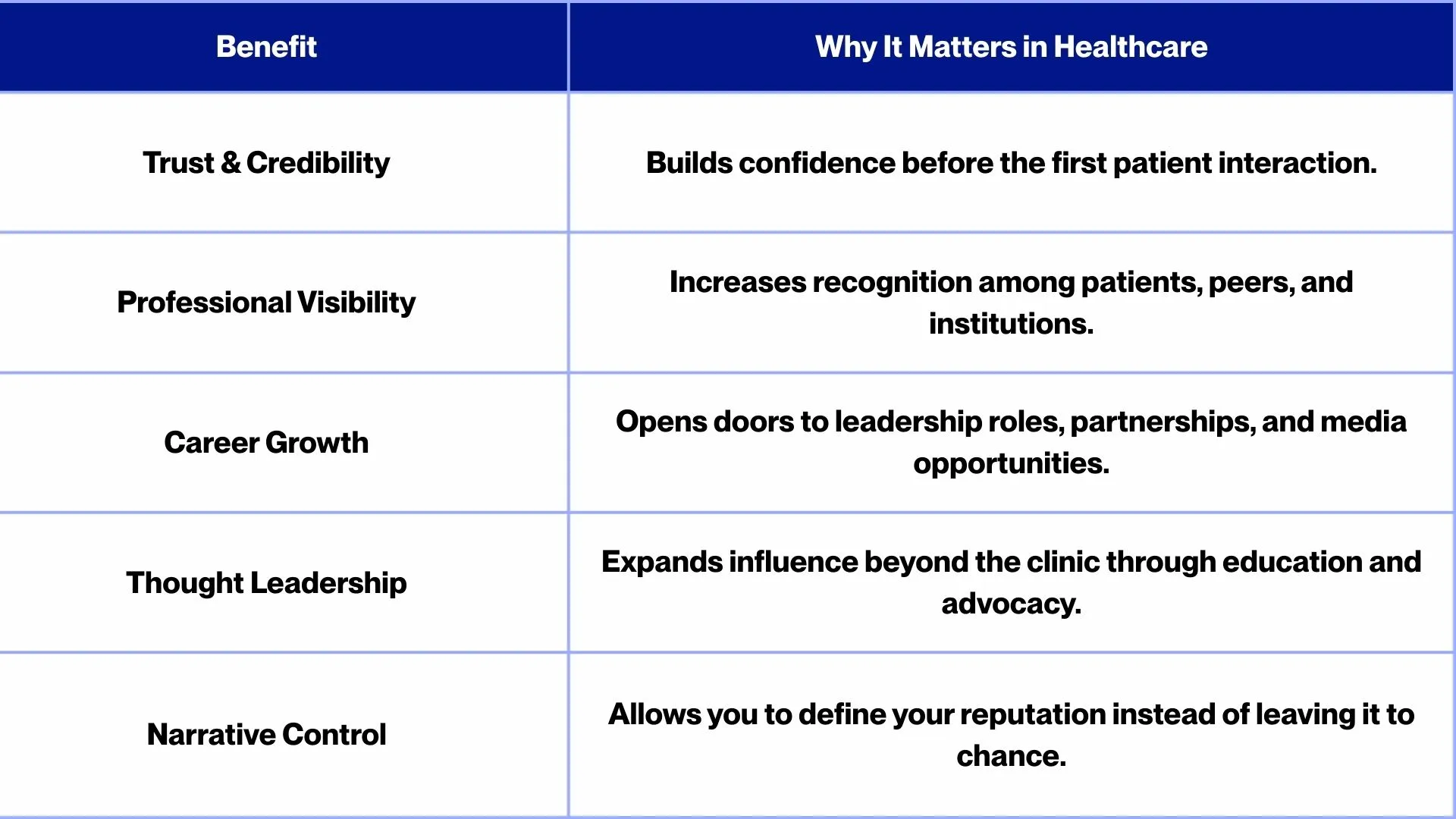
Why is branding important in healthcare? In a field where trust and credibility are paramount, branding plays a critical role in shaping patient perceptions. Healthcare branding, whether for an organization or an individual physician, is essentially about building trust and strengthening relationships. Patients aren’t just buying a service; they are often putting their health and lives in your hands. As such, they look for someone they feel confident in. Your personal brand can convey that you are knowledgeable, trustworthy, and compassionate before the patient even meets you.
For doctors specifically, your personal brand is inseparable from your practice. One marketing expert noted that in the eyes of patients, doctors aren’t just practitioners; they are the business. Patients now embark on a digital journey before choosing a provider, researching a doctor’s reputation, expertise, and even reading patient interactions and reviews. Managing your personal brand is therefore about more than ego; it directly ties to practice growth, patient trust, and even revenue.
If you don’t actively shape the narrative about you, it will form on its own, and possibly inconsistently or inaccurately. A neglected online presence can cast a shadow on your professional image, whereas a well-managed brand presents a consistent, positive story of who you are as a physician.
Building Trust and Credibility
A strong personal brand communicates your expertise, transparency, and commitment to patient well-being. When patients see a cohesive profile, accurate credentials, a bit of your personality, and positive testimonials, it reassures them that you are not only competent but also caring. Trust is the cornerstone of effective healthcare, and branding helps establish it early.
Differentiating You in a Competitive Field
There may be dozens of cardiologists or family doctors in your area with similar qualifications. Why should a patient or an employer choose you? Personal branding for doctors highlights what sets you apart – be it a special focus area, your patient-centered philosophy, or even your cultural or language skills. Good branding effectively conveys your value proposition and actively molds patient perception, helping differentiate you from competitors.
Attracting and Retaining Patients
A well-managed personal brand can serve as a magnet. By showcasing your unique qualities, specialties, and approach, you attract patients who resonate with your style of care. Likewise, existing patients feel a stronger connection and loyalty when they identify with your professional persona and values. In essence, branding can increase patient loyalty; patients are more likely to choose and stick with a doctor they feel they know and trust.
Enhancing Professional Visibility
In the medical community, your reputation can open doors. Branding yourself means actively participating in discussions, publishing, or being visible where it counts. For instance, doctors with strong brands often speak at conferences, contribute articles, or get interviewed in the media, which in turn raises their profile among peers and healthcare organizations. Personal branding ensures that medical professionals stand out and are easily discoverable by patients and peers. One example is Dr. Atul Gawande, whose personal brand built on thought-provoking writing and public speaking earned him opportunities far beyond the operating room.
Career Advancement and Opportunities
Building your brand can directly impact your career trajectory. Doctors with a strong personal brand may attract job offers, leadership roles, or partnership opportunities because they’ve established themselves as experts or innovators. Many doctors report that personal branding positively impacts their career opportunities, such as promotions or new roles. It can also bolster an academic career or speaking opportunities. A well-crafted brand effectively turns you into a known quantity so when your name comes up for a position or award, people have a positive notion of who you are and what you stand for.
Stronger Patient Relationships
Personal branding isn’t just about getting patients in the door; it’s also about what happens after. When your brand emphasizes approachability, empathy, or excellent communication, patients feel more connected and understood. If your online presence and communication style show you to be compassionate and attentive, patients are predisposed to trust you. For example, Dr. Betsy Grunch blends expertise with authenticity in her personal brand; her millions of followers describe her as knowledgeable and kind, which ultimately drives trust in her as a practitioner.
Thought Leadership and Influence
A physician’s voice can extend well beyond their clinic. By developing your brand, you can become a thought leader who influences public health conversations or medical best practices. Consider Dr. Kevin Pho: through consistent personal branding via blogging and social media, he now reaches millions. This kind of influence not only amplifies your message but also enhances your credibility. Patients increasingly value these authoritative voices, with a massive majority reporting that they trust insights from health influencers. A strong personal brand positions you to educate and inspire a far larger audience than you ever could one-on-one.
Defining Your Own Narrative
Some doctors feel that focusing on personal branding is just marketing fluff or even beneath the dignity of the profession. However, branding in healthcare is not about flashy logos or catchy slogans, it’s about trust, communication, and reputation management. Personal branding is about crafting a narrative that resonates. You already have a personal brand because people do form impressions of you; the question is whether you will shape that brand or leave it to chance. Importantly, personal branding is absolutely compatible with professionalism and humility.
It is not self-promotion in a vain sense, it is self-definition, telling your own story before others tell it incorrectly. This is especially empowering for groups in healthcare who historically got overlooked. Whether you are a doctor, a nurse, or any healthcare professional, claiming your narrative can be a tool of empowerment, visibility, and career growth.
Key Elements of a Strong Physician Brand
If you’re convinced that crafting your doctor's personal brand is worthwhile, the next step is figuring out how to do it effectively. Personal branding for healthcare professionals has some unique considerations like medical ethics and patient privacy, but it ultimately boils down to a few core elements.
Clarity of Your Unique Value and Mission
Start by defining what you want to be known for. Ask yourself: What is my unique value proposition as a doctor? This could be your specialty and clinical interests, your approach to patient care, or even a personal story that shapes your medical journey.
Perhaps you’re a family physician devoted to community health or a surgeon passionate about patient education, whatever it is, clarify it. Identify the core values and passions that guide you in medicine and use those to distinguish yourself. Try writing down a short statement of what you do and why you do it, essentially your mission as a healthcare provider. This clarity will inform all other aspects of your brand.
Consistent Professional Image and Presence

In personal branding, consistency is key. You want all the touchpoints, your face-to-face interactions, online profiles, website, and business cards, to tell a cohesive story. This includes visual elements like having a professional photo and a consistent name and title usage. Make sure you present yourself in a way that’s both authentic and professional.
For instance, use a high-quality headshot in your online profiles and website so people can literally put a face to the name. Dress and demeanor in that photo should align with how you are in practice. Consistency also applies to your voice and tone; if you’re informal and friendly on social media but ultra-formal on your website, that might jar followers. Find a professional tone that still feels like you and carry it across platforms.
Robust Online Presence
Having an online presence as a doctor is almost non-negotiable. When someone searches your name, ideally they should find a professional website or profile that you control. A personal website acts as your digital home base, a place to showcase your bio, credentials, services, and perhaps your articles or videos. It doesn’t have to be fancy, but it should be well-designed and up-to-date. Beyond a website, claim your profiles on platforms like LinkedIn, Doximity, or Healthgrades, and keep them current.
Social media is another powerful tool if used wisely. Different channels serve different purposes: Facebook might connect with local community and older patients; Instagram or TikTok can humanize you and reach a younger audience; LinkedIn can be for professional networking and thought leadership. You don’t have to be active on every platform, choose those that align with your goals and where your target patient demographic hangs out. Importantly, stay professional on these platforms: share health tips, news, and behind-the-scenes of your practice while respecting privacy.
Setting up and optimizing your Google Business profile is one of the fastest ways to boost your visibility to local patients. Ensure your listing has accurate info, address, phone, hours, and photos. Encourage happy patients to leave reviews. Having a well-maintained profile with good reviews not only helps patients find you but immediately establishes credibility.
Authenticity and Personality
One of the most important elements of personal branding is authenticity. Patients and colleagues can tell if you’re putting on an act or if your online persona doesn’t match reality. It’s crucial to be genuine about who you are and what you stand for. If you’re naturally warm and humorous, it’s okay to let that show in a professional way. If you’re more serious and data-driven, you might focus your brand on being the go-to expert for evidence-based advice. The key is to not try to be someone you’re not.
Being authentic also means being consistent in values. If you say you are passionate about patient education, make sure you actually spend time educating patients. Aligning actions with words is branding 101. Additionally, share your story where appropriate. Patients love to know the human side of their doctor. A brief version of your story on your website or in an interview can make you more relatable.
Patient-Centric Content and Education
Content creation is a powerful way to establish your expertise and provide value. This could mean writing blog articles on health topics, recording short videos with advice, or posting infographics and tips on social media. By sharing knowledge, you position yourself as a helpful authority. Patients appreciate doctors who go the extra mile to educate, as it signals that you care about their well-being. Over time, this content not only helps existing patients but also draws in new people who discover you via these resources. Regularly sharing educational content establishes a doctor as a reliable source of health information.
Engagement and Community Interaction
Building a brand isn’t a one-way broadcast, it’s a conversation. Engaging with others fosters a sense of community around your personal brand. This can mean responding to comments on your posts, answering patient reviews with professionalism, and being responsive to messages within reason. Active review management showcases transparency and dedication to patient satisfaction. It signals that you listen and continuously improve, which boosts trust.
Additionally, engage in professional communities by joining forums and contributing to discussions. Networking with peers online can increase your visibility and also earn referrals. Every conference you attend, every webinar you speak on, and every community health fair you volunteer at is an opportunity to reinforce what you stand for and broaden your reach.
Reputation Management
Proactively managing your reputation is crucial. This means regularly checking your profiles on review sites and addressing any issues. Encourage satisfied patients to leave reviews; often a gentle request or a follow-up text after a visit works. Positive reviews and testimonials are essentially social proof of your brand promises. Moreover, consider some level of public relations, such as writing opinion pieces or health columns for local media. Getting your name in reputable outlets can boost your recognition and credibility. Being featured as a local expert in an article immediately elevates your personal brand.
Excellent Patient Experience
All the online branding in the world won’t stick if the real-life experience patients have with you doesn’t match up. Your personal brand extends to the exam room and bedside. Strive to offer the kind of patient experience that you tout in your branding. Simple things like a warm greeting, making eye contact instead of staring at the computer, and clear communication create a positive experience that patients will remember. This is the operational side of your personal brand. Think about the emotions you want associated with your name, such as comfort, trust, and confidence, and ensure your day-to-day practice delivers that.
Crafting a Personal Branding Statement
A personal branding statement is a concise way to capture your professional identity and promise. Think of it as your elevator pitch or tagline, a one-sentence or one-phrase summary of who you are and what you offer. Crafting one is incredibly useful for healthcare professionals. It forces you to distill your unique value, and you can use it in your bio, introductions, or even mentally as a guide for what you want to project.
To write a personal branding statement, start by reflecting on your role, specialty, and what makes your approach special. A good formula to follow is: I am a [profession/specialty] who [does what/has what specialty] for [whom] to [achieve what result]. It does not have to include every part, but it should highlight your key focus and the mission behind it. This essentially acts as a mission statement that melds into your brand.
Healthcare Personal Brand Strategy Examples
Looking at a few examples can help spark ideas for your own statement:
A physician example: “Compassionate family physician dedicated to improving rural healthcare access through community outreach and cutting-edge preventive care.” This one line tells us the doctor’s specialty, their value, and what they strive for. It is specific and shows both personality and mission.
A specialist example: “Board-certified cardiologist combining innovative research with patient-centered care to conquer heart disease.” This highlights a blend of research and patient focus, implying advanced yet empathetic care.
A nursing example: “Registered Nurse with 20 plus years of experience, passionate about patient advocacy and mentoring the next generation of nurses.” This emphasizes experience and roles as an advocate and mentor, showing what the professional stands for beyond a job title.
An administrator example: “Experienced healthcare administrator driving quality improvement and patient satisfaction through compassionate leadership.” This clearly defines the role, the area of excellence, and the intended outcome.
Making Your Statement Stand Out
Good personal brand statements are clear, truthful, and tailored. They are not generic phrases like “experienced doctor providing quality care,” which could describe anyone. Instead, they incorporate what is unique about you, whether it is a focus area, a specific style, or a vision for change. They also avoid excessive jargon so they remain understandable to patients and general audiences.
To create your own, try a quick exercise. List your top two or three strengths or passions, such as pediatric asthma management or health equity advocacy. Think about the outcomes you care about, like keeping patients out of the hospital or equal access for underserved populations. Finally, combine them into a sentence that feels comfortable for you to say or write.
Evolving and Using Your Brand
Your personal branding statement can evolve over time. Early in your career, it might be more aspiration-focused, while later it might center on your accomplishments. The key is that it rings true to who you are at this moment.
Once you have your statement, use it on your LinkedIn bio, your website homepage, or in the "About Me" section of professional materials. It becomes a quick answer to the question "So, what do you do?" in a way that sets you apart. Internally, it also serves as a guide; if an opportunity does not align with your statement, it might not be the right fit for your career path.
Will Personal Branding for Doctors Really Help?
By now, you might be warming up to the idea of personal branding, but perhaps you still have some doubts. Let’s tackle a few common questions regarding the impact and future of this practice.
Will personal branding for doctors work?
Yes, personal branding works for doctors when done thoughtfully. It is essentially a form of strategic communication. It works in the same way that having a good reputation works – by making you the preferred choice for patients and employers. While it is not an overnight magic wand, consistency and authenticity over time lead to a busier practice, more referrals, and invitations for professional growth like speaking gigs or leadership roles. People gravitate toward individuals they know, like, and trust. Personal branding helps you achieve that on a broader scale.
Will personal branding matter in the future?
Personal branding already matters, and its importance will only grow. The healthcare landscape is shifting with the rise of telemedicine and increasing competition. Patients are becoming savvy healthcare consumers who actively choose providers based on their online presence and values. As healthcare gets more digitized, the human connection will be a key differentiator. Doctors who embrace branding now will likely set the standards for patient engagement in the digital era.
Will personal branding change healthcare?
It is already changing how the profession interacts with the public. Physicians with large online followings are debunking myths, influencing health policy, and bringing transparency to medicine. This leads to a more informed patient population and humanizes the profession by breaking the mold of the distant physician. While the medical community is still navigating the balance of professionalism and oversharing, the overall change leans toward open communication and a more trust-filled environment.
Can branding help if I am not a social media person?
Absolutely. Personal branding is not synonymous with being an influencer. It can be as simple as ensuring your online listings are polished and your professional message is cohesive. Even without social media, your reputation among colleagues matters for career advancement. Presenting at conferences, networking, and having a professional bio all contribute to your brand. It is about putting your best foot forward consistently, regardless of the platform.
Leveraging a Personal Branding Agency
Building a brand is a significant commitment, and many doctors find they lack the time to manage it effectively. Personal branding agencies for doctors specialize in crafting and maintaining a professional identity so you can focus on your medical practice.
Strategic Brand Development and Content
Agencies work with you to identify what your unique brand should highlight. They pinpoint your strengths and goals to draw out your best story. They can also handle professional content creation, generating blog posts, LinkedIn updates, and thought leadership service articles in your voice. This ensures your brand remains active even when your clinic is busy.
Website and Online Management
Your personal website is your digital home. Branding agencies often provide web designers to create sleek, SEO-optimized sites that attract patients. They also manage your social media presence, helping you navigate what to post and how to handle interactions while maintaining your reputation and flagging any issues for your attention.
PR, Networking, and Consistency
A good agency can open doors by pitching you as a guest for podcasts, securing speaking engagements, or getting your articles published in reputable outlets. Perhaps most importantly, an agency provides accountability. They ensure your brand does not fizzle out when your schedule gets swamped, maintaining the momentum of your weekly posts and professional outreach.
Whether you choose to build your brand independently or partner with professionals, claiming your narrative is a powerful tool for any healthcare professional. Every dedicated doctor has a story worth telling; it just takes a little strategy to ensure that story is heard.
Conclusion
Personal branding for doctors isn’t a trendy add-on to your career, it’s a powerful tool that can propel your practice and professional fulfillment to new heights. In an era where patients are savvy consumers and information is at everyone’s fingertips, how you present yourself as a physician beyond the exam room matters immensely. By taking charge of your narrative, you ensure that when patients think of you or search your name, they encounter a consistent message of trust, expertise, and compassion that you have crafted.
We’ve discussed how a strong personal brand can build trust before you even say hello, how it differentiates you in a crowded field, and how it opens doors from patient panels to podiums. We’ve also outlined practical steps – from sharpening your online presence to engaging with your community – that you can start implementing today. It takes effort, but the payoff is a practice filled with patients who are a great fit for you, a professional network that recognizes your value, and the personal satisfaction of knowing your work and identity align.
To circle back to those key questions: Will personal branding for doctors work or matter? The answer is a resounding yes. Personal branding works, and it matters more than ever. It’s already working for many of your colleagues who are leveraging it to grow their reach, and it will undoubtedly matter for the next generation of physicians navigating a digital, connected world. The sooner you embrace it, the more momentum you’ll have.
Finally, remember that you’re not alone in this journey. Whether you take a DIY approach or collaborate with experts like OhhMyBrand, there are resources and support to help you every step of the way. Personal branding is about showcasing the very best of what you have to offer as a healthcare professional. And if there’s one thing we know about doctors, it’s that you have so much to offer. So go ahead – craft your narrative, share your passion, and build that personal brand. Your future patients, colleagues, and even your future self will thank you for it. Contact OhhMyBrand today to learn more about how to transform your name into a brand that opens doors. Let’s work together to make you not only visible but unforgettable in your field.



.svg)
.svg)
.svg)
.svg)



.svg)