


Personal Banding For Entrepreneurs
What Is Personal Branding Positioning Strategy For Entrepreneurs In 2026?
In the digital age of 2026, your personal brand is essentially your professional reputation and it is the foundation for unlocking new opportunities. For entrepreneurs, a strong personal brand positioning strategy is not just a marketing nicety but a strategic necessity. It is how you differentiate yourself in a crowded marketplace, build trust with your audience, and ultimately drive business growth. This comprehensive guide will walk you through why personal branding matters more than ever in 2026 and how to craft a strategic personal branding plan to elevate your entrepreneurial success.
Why Personal Branding Matters for Entrepreneurs in 2026
Personal Branding for C-Level Executives: People connect with people, not faceless businesses. In 2026, marketing is still fundamentally about relationships. Potential clients and partners want to know and trust the person behind the business, not just the company itself. Whether you are a startup founder or a solo consultant, your personal brand humanizes your business and builds a bridge of credibility. In an era when artificial intelligence can automate content creation, authentic human presence has become even more crucial. AI can write, design and automate, but AI cannot be you.
Your energy, stories, tone, and perspective remain uniquely human. In fact, the most AI proof professionals today are those with strong personal brands because they offer something algorithms cannot provide, which is genuine human connection.
Trust through Authenticity
Audiences in 2026 are craving realness over polish. Overscripted corporate messaging and perfectly curated images no longer win hearts. Trust now comes from imperfectness, authenticity, and a consistent voice. People follow and support entrepreneurs who share relatable stories, honest insights, and even flaws, because it makes them human. Humans connect to humans, not templates or robotic messaging. Your personal brand vibe or how you make people feel when they encounter you online is far more influential than just having a slick logo or tagline. By sharing your values, mission, and personal journey, you create an emotional resonance with your audience that fosters loyalty.
Competitive Edge in a Crowded Market
With countless professionals active on LinkedIn and other platforms, standing out is vital. A clear personal branding positioning strategy defines your unique edge and the specific value you offer that others do not. When you deliberately position yourself as the face of your vision and values, you amplify trust and credibility for your business. In fact, a well positioned personal brand gives you a measurable competitive advantage by instantly communicating what sets you apart to decision makers.
Accelerating Trust and Buying Decisions
Trust is often called the currency of business growth, and personal branding helps mint more of it. Buyers and partners are far more likely to engage with a founder or leader who demonstrates clarity, consistency, and expertise through their personal brand. By showcasing your experience and mission consistently, you make it easier for others to believe in your capabilities and invest in your product or service. In short, people buy from people. Cultivating your personal brand builds that trust faster than any corporate ad campaign.
Opening Doors to New Opportunities
An entrepreneur with a strong personal brand does not chase opportunities because opportunities come to them. By increasing your visibility and credibility, personal branding ensures you get found and remembered by those seeking your expertise. This can lead to speaking engagements, press features, partnership offers, investor interest, and inbound leads that you might otherwise miss. As soon as your name is recognized as an authority in your niche, others will think of you first when they have relevant needs. Your online presence becomes a constant networking engine, drawing in prospects aligned with your brand.
Attracting Ideal Clients and Talent
Effective personal branding also acts as a filter, magnetizing the right clients, customers, or even employees to your business. When you clearly communicate your values and point of view, you tend to draw in people who resonate with your approach. This means higher quality clients who already trust you and are excited to work with you. By the same token, you will repel those who are not a good fit, saving you time and ensuring better relationships. In the climate of 2026, niche audiences and micro communities hold big power. You do not need everyone to follow you, just those who truly align with your brand message and value.
Long Term Growth and Resilience
Unlike short term marketing tactics, a personal brand is a long term asset that compounds over time. Every piece of content you publish, every speech or podcast you give, and every interaction you have are all deposits into a reputation bank. Over months and years, those deposits grow into a legacy. Entrepreneurs who invest in personal branding find that while it may not yield ROI in week one, it can lead to exponential results down the line. From higher pricing power to greater career flexibility, your personal brand continues to pay dividends in credibility and opportunity.
Key Trends in Personal Branding Strategies for 2026
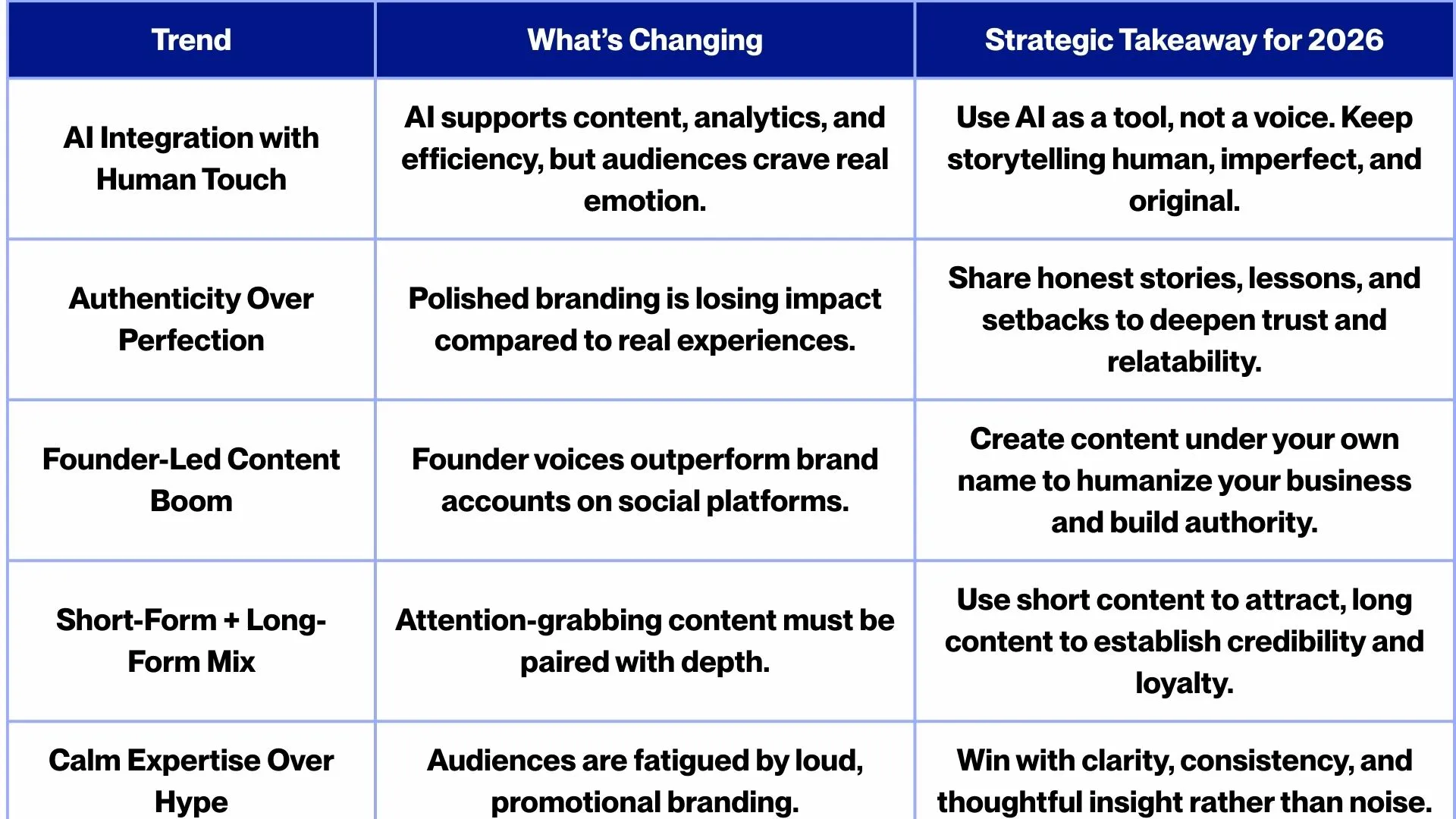
The personal branding landscape is always evolving. What worked a few years ago has matured, and new trends are shaping how entrepreneurs should approach their brand in 2026. Here are some of the notable trends and shifts to keep in mind.
AI Integration and the Human Touch
Artificial intelligence is transforming marketing and branding. This ranges from AI tools that optimize your profiles and generate content ideas to algorithms that influence what content gets seen. Savvy entrepreneurs are leveraging AI for efficiency, such as using it to analyze audience data or suggest content topics. However, the more we automate, the more audiences crave the human touch. Personal brands are countering the AI wave by emphasizing what is uniquely human: originality, empathy, and even imperfect storytelling that signals a real person behind the content. Use AI as a helper, but keep your personal brand voice deeply human. Your authenticity is your competitive advantage in a world of automation.
Authenticity Over Perfection
In an era dominated by polished feeds and corporate PR, authenticity is a breath of fresh air that cuts through the noise. Sharing personal stories, including failures or challenges overcome, and showing your personality makes your brand relatable. For example, a consultant openly talking about a tough client experience can resonate more than a generic success story. Entrepreneurs are learning that vulnerability and transparency can greatly deepen audience connection. In 2026, being real beats being perfect.
Founder Led Content Boom
We are seeing a surge of founders and executives stepping forward as the voices of their companies, especially on platforms like LinkedIn. Founder led content significantly outperforms brand led social media content. Audiences trust faces more than logos. This trend means as an entrepreneur, it is powerful to create content under your own name. Share your leadership perspective, industry commentary, and behind the scenes looks at your business. This humanizes your company and builds your thought leadership footprint.
Rise of Everyday Influencers
Along with founder voices, there is a trend toward micro influencers and niche experts carrying more influence than celebrity endorsements. In terms of conversion and trust, subject matter experts with smaller but engaged followings outperform celebrity influencers. People would rather take recommendations from a known industry expert or a peer than a distant superstar. This is good news for entrepreneurs because you do not need millions of followers to have an impact. By consistently sharing value in your niche, you can become a respected micro influencer whose word carries weight with the right people.
Short Form and Long Form Content Mix
Content strategy for personal brands in 2026 is all about a balanced mix. Short form content like video snippets and quick updates is fantastic for grabbing attention and expanding reach. Long form content like blog posts, newsletters, podcasts, or deep dive videos builds depth, authority, and loyalty. The winning combination is using both in tandem. For instance, an entrepreneur might use short viral videos as a hook to draw people in, then offer in-depth articles or a podcast that establishes their expertise. Plan a content mix that maximizes both visibility and credibility.
Community and Niche Focus
Bigger is not always better in 2026. Rather than trying to amass a huge generic following, many entrepreneurs are focusing on building micro communities. These are smaller, highly engaged groups of followers or members who share a common interest or niche. Participating in niche forums or specialized digital groups can yield more meaningful connections and business opportunities than shouting to a million random followers. Depth of engagement beats breadth of audience now. Identify the communities where your target audience hangs out and be active there. By being a known, trusted figure in a focused circle, you can become the go to person for that niche.
Calm Expertise versus Hype
An interesting shift noted by branding experts is that audiences are gravitating towards calm expertise. In past years, social media rewarded loud, hype driven personalities. But in 2026, there is fatigue over superficial hype. People appreciate voices that are confident yet calm, offering clarity over volume. This means you do not have to be the loudest person in the room to build a strong personal brand. You can focus on delivering consistent, insightful value and demonstrating mastery without the theatrics. Thoughtful analysis, educational content, and helpful advice can win over brash self promotion.
Steps to Create a Personal Branding Strategy in 2026
Crafting a personal brand might feel overwhelming, but it becomes manageable when broken into clear steps. Below is a step by step personal branding strategy guide for entrepreneurs, including how to define your positioning and exercises to clarify your direction. Follow these steps to build a compelling and strategic personal brand.
Self Discovery and Brand Audit
Every successful personal brand starts with knowing yourself and understanding how you are currently perceived. Begin with a brand audit of your digital presence. Search for your name online and check your social media profiles through the eyes of an outsider. What comes up? Is it consistent with how you want to be seen? If there is little to find, that is okay because it means you have a clean slate to work with. If you do find content, assess whether it aligns with your current goals or if some old posts need refreshing or removing to avoid sending mixed messages.
At the same time, engage in self discovery. Clarify your core values, strengths, passions, and the why behind your work. Ask yourself introspective questions: What is my mission? Why did I start this business? What values do I never compromise on? Who am I trying to help, and how do I want to impact them? The goal is to understand the authentic story at the heart of your brand because personal branding is built on relevance, not just self promotion.
One useful personal positioning exercise is to conduct a personal SWOT analysis on yourself as a brand. Identify your internal Strengths, such as expertise and unique skills, and Weaknesses, which are areas to improve or delegate. Then look at external Opportunities, like trends you can leverage or gaps in the market, and threats, such as competition or changes in technology. Writing out a SWOT matrix can reveal where you shine and what niche you can credibly own. Remember, everyone already has a personal brand by default. The point of this step is to consciously shape it by first understanding who you are and how others see you.
Define Your Unique Value Proposition and Goals
With self discovery in hand, articulate your Unique Value Proposition. This is the clear statement of what makes you different and valuable. In simple terms, your value proposition answers why someone should choose to follow or work with you instead of someone else. Think about what you do better or differently than others. It could be a unique combination of skills, a fresh perspective, a specialized niche focus, or even your personality and style of delivery. For example, maybe you are a marketing consultant whose value is bringing analytical rigor to creative campaigns, simplifying analytics for non technical clients. Or perhaps you are a fitness coach focused on holistic wellness for busy tech professionals. Make it specific and aligned with who you truly are.
Next, set clear branding goals. What do you want your personal brand to achieve in the next year or two? It could be becoming a recognized expert in a certain field, attracting a specific number of inbound leads, growing a social media following, or landing speaking opportunities in your industry. Define what success looks like for your brand. Also decide which industry and audience you want to be most visible to, as this will guide your messaging and channel choices. For instance, an entrepreneur targeting tech founders might set a goal to become a thought leader on LinkedIn among software startups.
Finally, distill your positioning into a concise personal brand statement. This is one or two sentences that encapsulate who you are, what you do, and for whom. A common format is identifying yourself as a specific professional who helps a certain target audience achieve a result through your unique methods. This is not necessarily a public facing tagline, but a guiding statement for yourself to keep your content and presence on message. A strong positioning statement will keep you focused and also serve as a handy answer for when someone asks what you are known for.
Identify Your Target Audience and Niche
Your personal brand cannot appeal to everyone, nor should it. To be effective, you need to zero in on who you are trying to influence or reach. Identify your target audience in detail. These could be potential customers, investors, industry peers, or any stakeholders relevant to your business and goals. The clearer you are about your audience, the more tailored and compelling your branding can be.
Create an ideal audience persona if that helps. Define their roles, their needs, and their interests. For example, your audience might be early stage e-commerce entrepreneurs looking for growth marketing advice or HR managers seeking leadership coaches. Understand what they care about, what language they use, and where they spend time online and offline. Your personal brand should speak directly to the people who matter most to your business. If you try to speak to everyone, you speak to no one, so focus on owning your niche.
Use your audience insight to refine your messaging. Make sure the content you create and the way you present yourself addresses the needs or aspirations of that target group. This might involve adjusting your tone. A tech CEO audience might prefer a more formal, data-backed tone, whereas creative freelancers might vibe with a more casual style. It also guides you on which platforms to prioritize. For instance, a B2B audience means LinkedIn is key, whereas a younger consumer audience might mean focusing on Instagram or TikTok. Ultimately, defining your audience helps ensure that when they come across your profile, they feel this person is for them.
Craft Your Brand Story and Messaging
Storytelling is at the heart of personal branding. Now that you know your strengths, positioning, and audience, weave these elements into a compelling personal brand story. This is the narrative that connects the dots of your experience, values, and mission in a way that resonates emotionally. It is not just a list of your accomplishments or a resume. It is a story that highlights why you do what you do and the journey that got you here. Perhaps you overcame a challenge that now fuels your business mission, or you noticed a problem in your industry that you became passionate about solving. Share those pivotal moments and lessons learned, as they add depth to your brand.
Ensure your messaging, from your LinkedIn bio to how you introduce yourself at events, consistently reflects this story and your value proposition. Keep the language clear and jargon free, and focus on the value you bring to others. Remember that your brand is not about you, it is about what you do for others. For example, instead of saying you are a skilled software developer with a decade of experience, frame it as helping fintech startups turn complex code into user friendly apps. This speaks directly to a specific audience need.
Do not be afraid to show some personality in your messaging. Personal branding is not meant to be as formal as a corporate press release. If you have a sense of humor or a particular style of communicating, let that shine through in a professional way. That is part of what makes your brand unique and memorable.
A useful exercise here is to list a few core messaging pillars or themes that define what you talk about. Think of three to five topics or values you want consistently associated with your name, such as data driven marketing or sustainability in design. These become the buckets for your content and the recurring motifs in your story.
Above all, be authentic and selectively transparent. You do not have to spill every detail of your private life to build a personal brand. Personal branding is about your professional story and your human side, not your privacy. You can share personal anecdotes that support your brand message, like a lesson learned from a failure, without sharing things that are too intimate. This keeps your brand relatable yet focused and relevant.
Build Your Online Presence and Content Strategy
Now it is time to put your brand into action where it counts. In 2026, having a strong online presence is non-negotiable for entrepreneurs. Start by optimizing your key profiles on platforms like LinkedIn, Instagram, TikTok, or YouTube, depending on where your audience is most active. Use consistent professional photos and handles, and ensure your bio or headline clearly states who you help and how. For instance, a LinkedIn headline should be concise and value oriented, clearly displaying your niche and your role. Your LinkedIn About section should be a first person narrative of your story rather than a resume, and you should use the featured section to highlight your best results or content.
Next, develop a content strategy to consistently showcase your expertise and personality. Content is the vehicle through which your brand reaches people and provides value. Decide on a mix of platforms and content types that play to your strengths. The key is consistency and quality. Establish a realistic posting schedule, such as publishing on LinkedIn three times a week or writing a blog post once a month, and stick to it so your audience learns to expect your contributions.
When planning content, ensure it aligns with your core themes. Provide value in every piece by educating, inspiring, or solving problems rather than just promoting yourself. A helpful guideline is the 80/20 rule: 80% of your content should be value-add, such as sharing insights or industry commentary, and no more than 20% should explicitly promote your services. This keeps your audience engaged without feeling sold to all the time.
It is also wise to diversify your formats by mixing short form and long form content. Short form videos or graphics are great for quick engagement and broad reach. They act as a modern business card, grabbing attention and making a quick impression. Long form content, such as detailed articles or tutorials, establishes you as a deep authority and improves your long term discoverability. A winning strategy in 2026 is to use short form for reach and long form for reputation. A quick infographic might draw people in, while an in depth guide converts that interest into trust.
Whatever the format, aim for consistency in tone and scheduling. Showing up regularly in your audience's feed builds familiarity and helps people associate your name with your niche insights. Tools like content calendars can help maintain this regular output. If you struggle with ideas, refer back to your core content pillars and rotate through them. You can also repurpose one piece of content into several others, such as turning a video into a series of social media posts.
Lastly, ensure your visual branding and voice are cohesive. While personal branding is about more than just logos, maintaining a consistent look and feel reinforces recognition. Use a uniform set of colors or styles in your graphics, maintain a similar photo style across all platforms, and keep your writing voice consistent. This professional and deliberate approach across all touchpoints builds significant trust with your audience.
Engage and Network Strategically
Building a brand is not a one-way broadcast; it is a conversation. Engagement is the lifeblood of personal branding. The more you interact authentically with others, the faster your reputation and network will grow. In 2026, this means deliberately networking both online and offline to expand your reach and credibility.
Start by engaging on the platforms where you are active. For example, if LinkedIn is your main stage, do not just post content. Comment on the posts of others and participate in discussions. Commenting on the work of relevant creators or industry leaders is one of the easiest ways to increase your visibility without even posting original content. Aim to leave thoughtful comments that add value rather than just generic praise. This puts you in front of that person's audience, attracting new connections and followers. Over time, people will start recognizing your name and associating you with insightful contributions.
Simultaneously, build your strategic network. Connect with people who are influential in your industry or who represent the exact audience you want to reach. Send personalized connection messages that mention a common interest or something you liked about their content. Join niche groups, forums, or communities where your target audience gathers and be a helpful participant there. The goal is to become a familiar and trusted figure in the circles that matter most to your brand.
Do not forget offline networking. Attend industry conferences, local meetups, and speaking events. When possible, raise your profile by speaking on panels or giving talks. Nothing builds credibility like being seen as an expert on stage. Even attending and asking insightful questions can get you noticed. Always have your personal elevator pitch ready for these real life interactions, tying back to the story and value proposition you have crafted.
Remember that relationships build brands. Personal branding has evolved into founder-led marketing, where your interactions become assets for your business. Nurture these relationships intentionally by following up with people you meet and offering help freely. Look for collaboration opportunities, such as guest posting on a blog or inviting a fellow entrepreneur for a joint live stream or podcast. By aligning with other voices, you cross-pollinate audiences and bolster each other's brands.
Effective networking is about giving value first. Share the content of others, celebrate their wins, and connect people who could benefit from knowing each other. By being a connector, you foster goodwill that often returns to you. As your network grows, so does your social proof. Finally, consider cultivating a small community of your own, such as a newsletter or a private digital group. This allows you to deepen engagement with your most interested followers and positions you as a leader rather than just a content producer.
Monitor Your Brand Reputation and Evolve
Lastly, remember that personal branding is an ongoing process, not a one-time project. You need to monitor your brand performance and public perception, and be ready to adapt as you and the market evolve. Set up metrics or indicators of progress based on your initial goals. These could be quantitative, such as growth in followers, engagement rates on your posts, or the number of inbound inquiries you receive. They could also be qualitative, such as the specific feedback you hear from peers or whether you are increasingly recognized as an expert in your industry. Tracking your progress is vital to understanding the impact of your branding efforts.
Use analytics tools where available. Platforms like LinkedIn and X provide data on profile views and post reach, while your personal website can use tools to track traffic. Observe which content pieces get the most positive responses and which seem to fall flat to refine your strategy. You might find that your audience engages more when you share personal founder stories than when you post dry statistics. This is your cue to include more storytelling. If certain sub-topics are getting more search engine hits, you may have found a niche interest to lean into more heavily.
Regularly search for yourself online to see what appears on the first page. This is effectively your digital first impression. Ideally, your own content, such as your website or LinkedIn profile, should dominate these results. If outdated information or someone else with a similar name appears, you may need to create more content to ensure your intended brand is what people find. Setting up alerts for your name can help you catch new mentions in media or blogs so you can respond or share them quickly.
It is also a good idea to solicit feedback from trusted people in your network. Ask a colleague or mentor to review your online presence and give honest feedback on whether your branding conveys what you want it to. You might be surprised by insights that help you tweak your messaging or design. Personal branding is iterative, and it is okay to pivot your content focus or rebrand aspects of yourself over time as long as you maintain authenticity. Even top entrepreneurs reinvent their personal brands as industries change.
Above all, be patient and stay consistent. Building a notable personal brand does not happen overnight. It accrues with persistent effort. In the early stages, you might feel like you are speaking into a void, but personal brands compound like interest. Many people quit after a few months because they do not see instant fame, not realizing that branding is about being remembered in the long run rather than just being noticed once. Each piece of content and each interaction is a small deposit in your reputation bank, and those deposits will grow exponentially if you keep at it.
Set a long-term horizon for your personal branding journey. You are building an asset for the next decade of your career, not just a quick campaign for this quarter. If you stay true to your message, consistently provide value, and refuse to quit, you will steadily convert that personal brand into a lasting legacy and opportunity. The best time to start was yesterday, but the second best time is today.
Examples of Personal Branding Success in 2026
Looking at real-world examples can be inspiring and instructive. Here are a few personal branding strategy examples in 2026 that show how entrepreneurs and professionals have positioned themselves to great effect.
Justin Welsh: The Solopreneur Content King
Justin Welsh is a former SaaS executive who left corporate life to build a one-person business. His personal brand strategy focuses on sharing useful, no-nonsense business content on LinkedIn and through his newsletter. By consistently posting daily insights and engaging with his community, Justin grew his LinkedIn following to over 800,000.
By early 2026, his personal brand driven business generated over $12 million in income with 90% margins, all without a large team or paid advertising. The key takeaway from Justin’s example is the power of consistency and utility. He chose one primary platform and niche, delivered value relentlessly, and systematized his content. His brand is now synonymous with solopreneur success, proving that a strong personal brand can be a high growth business engine.
Sahil Bloom: From Finance to Influencer Investor
Sahil Bloom began as a finance professional and transformed into a major thought leader by harnessing X and LinkedIn. His strategy involved writing viral long-form threads that distilled complex business and life concepts into simple stories. By consistently delivering clarity, Sahil grew his audience into the millions across social media and his newsletter, The Curiosity Chronicle.
In 2026, Sahil’s personal brand positions him as a bridge between high level finance and personal growth. This reputation has opened significant doors, allowing him to launch venture funds and become a prolific angel investor. His journey shows that a strong personal brand can pivot your career. Sahil went from working in private equity to being an entrepreneur and investor on the back of the trust he built through his content.
Ali Abdaal: The Educator Entrepreneur
Ali Abdaal is a former doctor who built a personal brand empire around productivity and intentional living. He started by sharing study tips on YouTube, and his approachable style resonated globally. Over the years, Ali consistently published long-form videos that combined personal experience with evidence-based advice.
By 2026, Ali’s community has grown to over 8 million followers across social media. His personal brand has expanded into a New York Times bestselling book, Feel-Good Productivity, and various online academies. Ali’s example underlines the importance of authenticity. He built trust by being genuine and focusing on helping his audience improve their lives. His journey illustrates that if you consistently deliver on your brand promise, you can turn content into a diversified multi-million dollar business.
Personal Brand as Company Brand: Elon Musk and Oprah Winfrey
It is worth mentioning how world-renowned entrepreneurs use personal branding to boost their companies. Elon Musk has an enormous personal following and often serves as the primary news and marketing channel for Tesla and SpaceX. His persona is tightly linked with the brands he leads, garnering billions in free publicity from a loyal fanbase.
Similarly, Oprah Winfrey’s personal brand of empathy and empowerment became the cornerstone of a global media empire. While you may not be a billionaire, the principle holds true. By positioning yourself as the face of your vision, you amplify trust in your business and turn your company into a movement. Partners and consumers feel they know you, making them more invested in your success.
Conclusion: Embracing Strategic Personal Branding in 2026
By now, it should be clear that developing a strategic personal branding positioning strategy in 2026 is one of the smartest investments an entrepreneur can make. It is about much more than ego or online popularity. It is about intentionally shaping the narrative around yourself so that it propels your business and career forward. In an increasingly digital, trust-driven marketplace, your personal brand is often the deciding factor in opportunities and relationships. It can differentiate you from a sea of competitors, humanize your business in an age of AI, and create a pipeline of trust that leads straight to your door.
As you implement the steps outlined, from self-discovery and defining your niche to consistent content creation and networking, remember that the heart of personal branding is being true to yourself and genuinely helpful to others. Strategic does not mean insincere.
On the contrary, the best personal brands are grounded in authenticity and built with intention. Think of your personal brand as an extension of your values and commitment to your audience. When done right, personal branding strategies for entrepreneurs are essentially about serving your audience with your unique expertise and being recognized for that.
Finally, be patient and persistent. If you start today, you will not instantly become a thought leader by next week, but you will be planting seeds. Give it the time and consistency it deserves. There is always room for another authentic voice. The only way to guarantee you will not build a strong personal brand is to never start or to give up too soon. Every day you stay consistent is a day closer to your breakthrough moment.
Embrace strategic personal branding in 2026 as an ongoing journey. Adjust your sails with the trends, keep your eyes on your long term vision, and stay genuinely engaged with your community. Do this, and you will find that your personal brand becomes a powerful engine for trust, opportunity, and growth. This is an engine that can carry both you and your business to new heights in 2026 and beyond. Good luck, and get branding! Contact OhhMyBrand today to learn more about how to transform your name into a brand that opens doors. Let’s work together to make you not only visible but unforgettable in your field.


.svg)
.svg)
.svg)
.svg)



.svg)